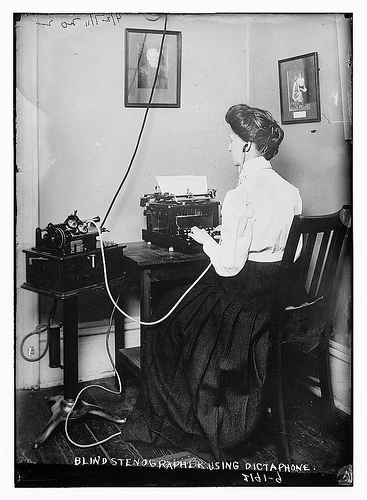
What is a sole trader?

Library of Congress 1911

There’s a discussion going on over at LinkedIn about what it is that makes people go freelance.  Reading the comments started me thinking about a more fundamental question.  Not “what’s so attractive about freelancing?”, but “what is a freelancer?” – or given the title of my blog, “what is  a sole trader?” And do they count as businesses?

 When is a business not a business?

This is not such a dumb question as it seems.  The most common search terms that land people at my blog are about sole trading – from the slightly baffling “Is Rupert Murdoch a sole trader?”, to the more general “What is a sole trader?”

The dictionary definition is helpful, but being a sole trader is a slippery thing to pin down. (By the way, I should say that I’m using the terms freelance and sole trader interchangeably to mean one person working for him or herself.  They aren’t necessarily the same thing.  And to be strictly accurate, I’m not a sole trader myself: I’m a Limited Company.  I just didn’t think Limited Company PR was a good title for a blog.  There’s some advice on the differences between sole trading and limited companies here)

Anyway, whatever you call me, I  am a business.  I’m registered at Companies House and with the VAT office.  I have an accountant to help me sort out my corporate tax.  My heart swells with pride when we entrepreneurs are hailed as the saviours of the British economy.  But I’m also not a business as its commonly understood: I don’t have premises (I work from clients’ offices or at home) I don’t have staff, I don’t sell a product other than the ideas I generate, so I don’t have production line, warehousing or distribution problems to solve; I don’t need much equipment (printer, laptop, phone, kettle).  I work with lots of small businesses who face all these issues, so I understand the problems.  I just know that I don’t share them.  And neither, I’d guess do many of the 3.6million other companies without staff – rather insultingly classed as “zero businesses” – which are estimated to be in operation at the moment.

Advice for Sole Traders

This seems like a small point, except when it comes to looking for ideas for developing my business.  Small business advice services are geared up to help the businesses with the staff and premises to worry about.  There isn’t much for me on the recently launched (and already much derided) StartupBritain though as my needs are pretty simple  I can work out most things for myself.   But, just in case Rupert Murdoch’s reading and is thinking of branching out as a sole trader, here’s some online advice (though I’m not a tax, insurance or legal expert, so I’d seriously advise him to check with a professional)

Because sometimes age beats youth…

There was a flurry of interest earlier this year in the CIPR survey which revealed that although PR is a largely female-dominated industry,  fewer women than men occupy really senior positions.  I’m getting interested in another nugget of information buried in the survey – the age profile of PRs with in-house roles compared to freelancers.

Apparently “by far the greatest percentage (50%) of in-house … members are aged between 25 and 34. Practitioners aged 45-60 significantly dominate the freelance sector, with 51% of freelancers within this age range.” 

That feels perfectly understandable.  PR is a discipline that suits freelancing brilliantly.  Armed with a laptop, a broadband connection and a mobile you can work when and where you want – a  boon for women juggling work and childcare.  I’m starting to think that there may be a more sinister element to this, though I could just be paranoid.

There have always been rumours that recruitment consultancies don’t take candidates in their 40s seriously.  My experience and that of friends and contemporaries certainly seems to  bear that out at the moment.  I apply for the occasional interim job to mix it up with the freelancing.  Rather than being proud of the 20+ years on my CV and the huge range of experience that I can offer an employer, I’m starting to wonder what I can cut so that I don’t end up on the she’s-older-than-God pile before I have  chance to talk to them.  Are there so many freelancers  over 40  because we can’t get anything more permanent?

Ironically, being 40+ should be an advantage these days.  As the population ages communicators need to reach a mature and media-savvy audience which won’t accept being patronised or pigeonholed.  I’m doing some work at the moment for a client who’s putting together a health campaign aimed at people over 55.  They have smart campaigning ideas, a track record in generating fantastic creative work and great technical expertise in delivery, but they’re planning a campaign that risks turning off a sizeable chunk of its target audience because they don’t understand it.

I fondly remember being  27, single and childless.   I had no possible idea what it might be like to be  middle-aged, coping with children, job and mortgage, occasionally waving at my similarly harassed husband as we pass on the stairs, one to make dinner, the other to pick up a child from cubs.   I certainly had no idea  how it might feel to face getting older.     Those are increasingly common experiences.  Understanding them should be a huge advantage.  One of my industry heroines, Jilly Forster , has been stressing this point for years.  I’m watching the progress of Forster’s AGEncy with interest –  and it already seems to be paying dividends for them.  Others please note!

5 things to remember in between jobs

As I secretly knew it would, the job drought has ended and I’m back fretting about  having to work through the weekends again.  This seems like a good time to jot down some hard won advice about dealing with slumps – not least so that I can read it back when the next one crops up.

1. Jobs travel in packs and use unreliable forms of transport.  It’s perfectly normal for there to be gaps between jobs and then for people to be  falling over themselves to snaffle you up.  I’ve never met a freelancer yet who was busy all the time (and wasn’t lying about it).  Keep a spreadsheet of your work patterns and you’ll see that troughs are inevitably followed by peaks (and vice versa) – nothing lasts forever.  This can be quite comforting when the cupboard is bare, and fooling around with the spreadsheet on quiet days can almost feel like work.  Although…

2.  No-one can job-hunt for 24 hours a day, even though it is tempting to try.  With LinkedIn and other resources on tap you can fool yourself that you’re doing valuable things  just because you’re at the computer.  If you have really exhausted all the leads you can think of (and aren’t just avoiding  another awkward call) give yourself permission to go away and get a life.  Play the piano, contemplate painting the bannisters, torment the cats, leave the house and do something exciting you can use as raw material for your blog.  Remember that one of the reasons you probably had for going freelance in the first place was to kick the “life” part of your work-life balance back into action.

3.  However tempting, don’t take the first job that comes along just because it’s a job.  If it doesn’t fit your core skills or add something to your business it will just end in unnecessary unpleasantness.  Having just done this (again) and with the bruises to show for it,  I am aware that this is a hard one to learn.  Avoiding doing crap jobs was another reason I went freelance and is the reason that I…

4.  Put away a slug of money out of each pay cheque  to act as a cushion when the slumps come along.  This also allows you the smug glow that comes with saying “no” when someone asks if you’d like to do a crap  job,  and it helps deal with point 5…

5.  It ALWAYS takes longer to get work sorted out than you think it possibly can.  Potential clients are always just jetting off on holiday and promising to “pin things down when I get back”,  or need budget approval from a finance committee that meets once a quarter in alternate leap years, or just get tied up in meetings about other things.  The thing to remember is that, eventually, you will work again – and if you doubt that go back to point 1 and start again…