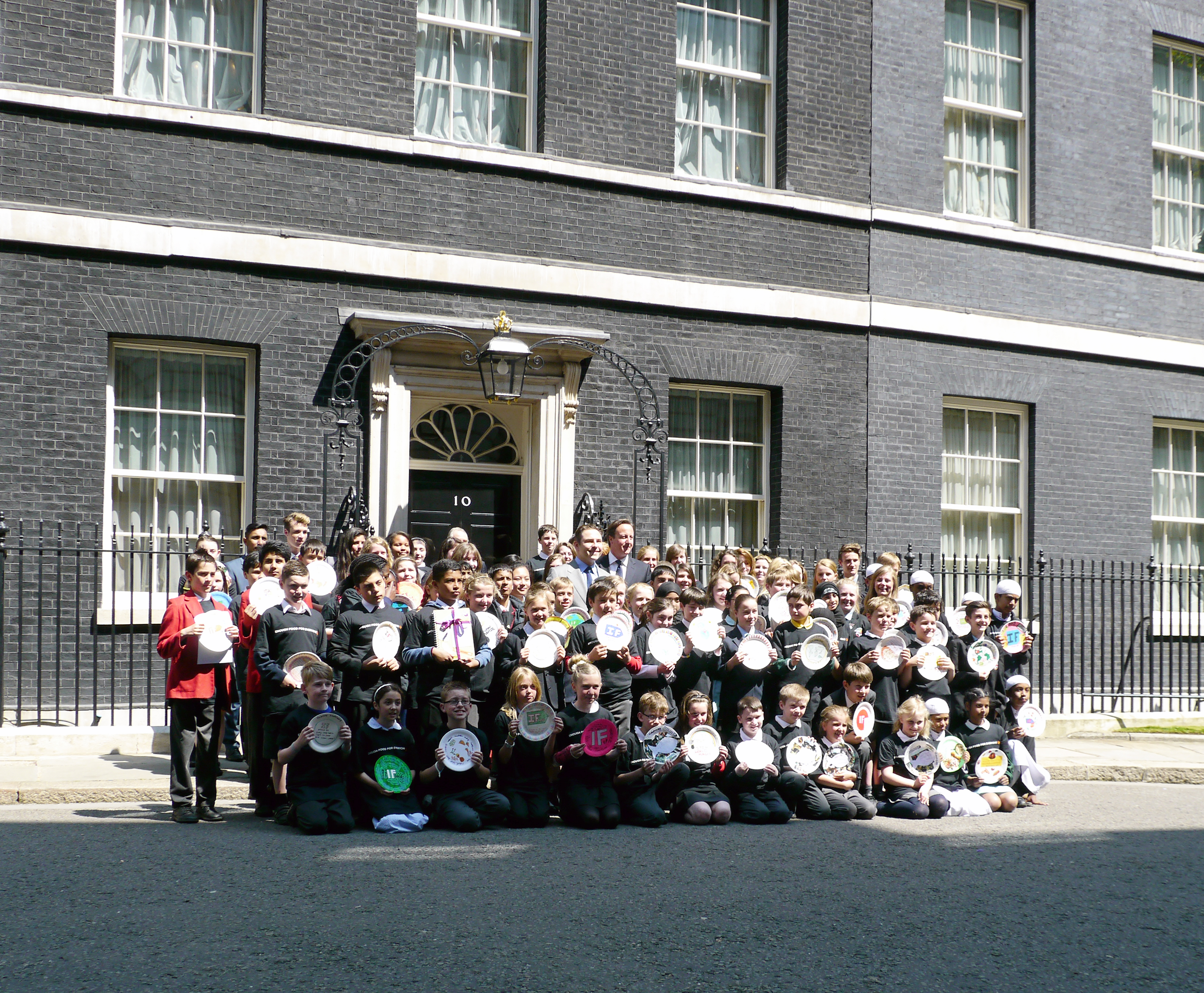
Young people and politics – not just a photo op

School delegation for If campaign

Yesterday this group of young people went to Downing Street to meet the Prime Minister. as part of the Oxfam “enough food for everyone”, If campaign.  When they got there they were kept waiting without explanation, not given the time to put their (pre-submitted, vetted and approved) questions to the PM and herded about by some aggressive PR handlers who really wanted to get the picture op over and done with. The questions were fielded instead by actor David Walliams who was there too – and handled the whole thing with aplomb, apparently.

I know this because my daughter was part of the delegation.  Her opinion of Mr Cameron – admittedly not high to start off with – has dropped a few more notches. Her cynicism about politicians has been reinforced.  I really hope that Oxfam got some pictures they can use – it’s a great cause.  Equally,  I really hope that No 10 don’t ever trot these images out as an example of successful engagement with young people.  I’m sure David Cameron has many, many important things to do in his day. Finding time to meet young people interested enough in the state of the world to get involved in a campaign like this should be one of them.  I’m equally sure that whenever these guys are old enough to vote they won’t have forgotten the way they were treated when they went to Downing Street.

Who the hell’s doing the Tories’ PR?

Having spent last night watching Hackney burning on TV and listening to police sirens screaming past on the road outside, I appreciate that there are more important issues at stake than David Cameron’s PR.  But, this blog is supposed to be about communications, so what the hell:

Who on earth is in charge of Tory PR?  And why did they not have the PM on a plane back from Tuscany immediately after the first night of rioting in London?

For once I have some sympathy for the politicians –  what on earth do we expect them to do when they get back?  As Shaun Bailey put it on Newsnight :

 “This is the thing that the media have been most childish about.  Do you think that David Cameron’s going to go down there with a shield and deal with the kids in Tottenham and then run over to Hackney?  We have a mechanism.  This is a big sophisticated society.  The police are here … we have leaders.  We have a Deputy Prime Minister, a Deputy Mayor, we have all manner of people.  The point is this, they are not the people who will put this problem right.  This problem is in our communities and in our economy.  What are our young people going to do for a job?  … We have lost control of our young people and that is our responsibility not politicians’ “

But whether there’s a practical need for them to be here or not, the image projected by the absence of senior ministers is poisonous to the Tories because it suggests that either:

  • they have no idea what to do and are hiding from the cameras so that they don’t reveal this to an anxious public;   or
  • they don’t want to get into a row – about cuts to police and youth services, or about soaring youth unemployment, or about how (if?) the clean-up will be paid for;    or
  • they simply don’t care – poor communities destroying themselves in unfashionable parts of London don’t matter enough to interrupt a holiday.

I think it’s the last one that’s the one that’s most damaging.   Cameron, Boris, Osborne, privately educated, Bullingdon-clubbers and multi-millionaires to a man, they already look startingly out of touch with “real people”.  It’s all too easy to imagine that they couldn’t care less about what happens on Mare Street.

Cameron cares about his image – that’s why he was  so sensitive to criticism for not tipping a waitress that he went back to find her.  But his priorities are badly wrong.  He should have been  here, striding purposefully about in Tottenham, talking to residents with a furrowed brow, sympathising with distraught shop-keepers and homeowners and promising that help is on its way.

Of course he’s back now, but it’s too late. In PR terms the damage is done.  The mood music is clear – they don’t care, they don’t act, we’re all in this together at the mercy of the mob,  they’re enjoying holidays in expensive private villas.  They’re the nasty party again.  Little by little the brand is being re-toxified.


Government comms – cock-up or conspiracy?

I’m amused that people are claiming to see dirty tricks afoot in the government’s climb down on the forestry sell-off.  There was a round of applause when it was suggested on last night’s Question Time that the whole thing was a set-up to present the government in a caring and listening light and to deflect attention from more nefarious goings on in health and education.

Having worked in Whitehall, I’m always amazed that people think government is efficient enough to put a conspiracy together.  Given the choice between something being down to cock-up or conspiracy I would bet the mortgage on it being a cock-up every time.  Government is too big, leaky, dumb and chaotic to manage the nimble footwork, discipline and cunning required to manage a conspiracy,   it certainly couldn’t raise the wherewithal to do it over this.  The simplest explanation is the best – they messed it up, didn’t listen to anyone before they announced the policy, hadn’t thought through the politics of it and were astonished at the response.  Another one to chalk up to my growing list of examples of how bad government comms is at the moment.

Perhaps David Cameron’s past life as a PR came to his aid when he killed the policy.  Standard advice  in crisis comms  is to act swiftly and decisively, accept blame where it’s due, put counter-measures in place fast and apologise sincerely.  All of which they more or less achieved.  I do wonder about the longer term damage to the Tories’ corporate reputation, though.  Ed Miliband has already made the point that cuts are reviving memories of Thatcher and “re-contaminating” the Tory brand.   At least the Thatcher governments maintained a reputation for being steadfast in the face of opposition. How many more U-turns driven by poor policy planning  can this lot afford before their public image is of malign but incompetent toffs blundering through things they don’t understand?

How many poll taxes fit into an area the size of Wales?

There are many shorthand measures used by newspapers to indicate size: Wales for geographical area, Wembley for crowds, swimming pools for volume, Nelson’s column for height, double-decker buses for dinosaurs (a rather specialised subset).  There seems to also be one newspaper measure for showing just how big a problem a politician has got himself into: the Poll Tax.

For Blair, ID cards, university top up fees and inevitably Iraq all got the “Is this Blair’s Poll Tax?” treatment.

Gordon Brown had fewer Poll Tax moments – perhaps he just had less time to stumble into them, although Polly Toynbee was worried that it might be the Tube.

For David Cameron, overwhelmingly it’s NHS reform, although Socialist Worker wants it to be tuition fees,   Labour Uncut feels it could be the housing crisis  and the TUC is warning about the whole package of cuts.

How young do you have to be before the Poll Tax ceases to be meaningful as something which happened during your political lifetime and becomes something that has to be set into context – in the same way that I had to have  Suez explained when it was the standard measure for British humiliations in world affairs (I grew up in the 1970s, there were LOTS of those).

The Poll Tax riot was in 1990.  Thousands of people who voted in the general election  weren’t born when it kicked off.  Does it mean anything to them or is it time for the hacks to stop being lazy?

Update:  Just checked, following today’s Big Society-debacle headlines.  No-one has actually called the BS David Cameron’s Poll Tax – yet.  The WSJ has already described the Big Soc as “the silliest idea to have come out of the party since the Poll Tax” so it’s probably only a matter of time.

Burn baby, burn

The bonfire of the qangos might not be such a popular rallying cry if the quangos themselves could  point to some hard evidence of their own achievement.  As David Cameron gets his matches ready, there’s a desperate need for NDPBs (and grant-funded voluntary sector bodies too) to be able to demonstrate that they represent value for money.  Sadly, in my experience, staff in bodies like this are happiest when they’re talking about the (undoubted) social need for their services and the benefits they were set up to deliver.  Mention of evaluation, demonstrating value for money, even – heaven forbid – the need to become self-supporting by selling commercial services, makes them come over giddy as a Victorian vicar accidentally catching sight of an uncovered table leg.  They should all be in a tearing hurry to get measures in place which demonstrate hard evidence of their usefulness.  If they can’t it’ll be hard to grieve too much when they start to smoulder.