Gunning for the BBC?

Total_BBC_Refresh_V3_-_old_logos

Has the public consultation to find out how the public feels about the BBC been  designed  so that the fewest people possible will respond to it?

The consultation is embedded in an 88-page document  with a two-page glossary of terms – (you can go straight to the questions online, if you prefer). I imagine it’s pretty impenetrable to anyone not familiar with the jargon of the broadcasting industry. I worked at the BBC for five years and Channel 4 for three and I found it pretty hard going. I suspect that many people who want to express their views on whether the BBC should or shouldn’t be doing Strictly, or how much they would be prepared to pay (or not) for Radio 4 will look, perplexed, at some of the questions they’re being asked and give up and do something else instead:

1   How can the BBC’s public purposes be improved so there is more clarity about what the BBC should achieve?

2   Which elements of universality are most important for the BBC?

3   Should Charter Review formally establish a set of values for the BBC?

10  How should the system of content production be improved through reform of quotas or more radical options?

14  How should the BBC’s commercial operations, including BBC Worldwide, be reformed?

15  How should the current model of governance and regulation for the BBC be reformed?

16  How should Public Value Tests and Service Licences be reformed and who should have the responsibility for making these decisions?

18  How should the relationship between Parliament, Government, Ofcom, the National Audit Office and the BBC work?  What accountability structures and expectations, including financial transparency and spending controls, should apply?

19 Should the existing approach of a 10-year Royal Charter and Framework Agreement continue?

I put some random sections of the consultation document through the Gunning Fog  index. GF is an academic tool which measures the readability of a piece of writing. The people at GF estimate that:

Texts for a wide audience generally need a fog index less than 12. Texts requiring near-universal understanding generally need an index less than 8.

As a rough rule of thumb I assume that the index relates to the years of formal education a reader will need to have had in order to understand something, so a piece of text with an index of 12 should be clear to an A-level student. The sections I analysed came back with an average GF index of 14.8, one section came in at 15.5. Either DCMS doesn’t know, or doesn’t care that the public consultation about the single most important cultural institution in the country may only be understood by people with a degree-level education who  know what accountability structures are.

I have additional worries about what will happen to the consultation documents when they are submitted. Will they be read (not a flippant question – I have sat in Whitehall meeting rooms with piles of unread consultation documents in a corner because no-one had the time to read them all). Who is going to analyse responses which will come in in the form of several thousand online free text boxes as well as via email and in the post? What kind of common measurement standards will they apply? And let’s not even mention the hanging jury which seems to have been assembled to assess the Beeb’s future options. For the time being let’s just concentrate on getting the public’s voices heard.

The Save Our BBC campaign has written to Culture Secretary John Whittingdale asking him to make sure that a Plain English Crystal Marked version of the document be produced. You could do the same,  or you could write with your general feelings about the BBC (good or bad, just have your say), and you could copy the letter to your MP (find him/her at They Work for You). Ask them to do whatever they can to make sure that the BBC gets a fair crack of this particularly dangerous whip.
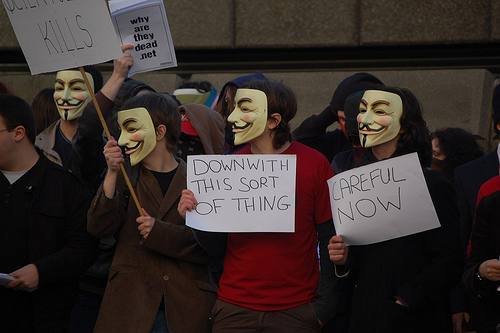
The people have shrugged – the bastards

Came away from last night’s programme about reconnecting people with politics sadly disappointed that as an electorate we are badly failing our MPs.  It’s a wonder they can find the will to carry on.

We don’t go to their meetings (possibly because when we do we get harangued about doubting their integrity).  We don’t vote. We don’t respond to their blogs – although that side of the experiment seemed to die as soon as it was born and, as any fule kno, these things take time.  Not even Chris Brogan could build a vibrant blog community in a few weeks.   (And is anyone else as irritated as I am with the number of MPs who just use Twitter as an advertising channel for their activities?  Tom Harris, an MP who knows how to do these things, had a great blog post a while back with top tips for political tweeting which started with : 1. Don’t just broadcast – engage. Politicians who use social media to let everyone know what they think but who don’t even respond to others’ views are doing themselves no favours.  Quite right too.)

Anyway, back to last night’s MPs.    According to Ann Widdecombe we don’t even care enough to tell them what it is we don’t like so they can do something about it. (“They just shrug… I’ve been facing it for years… The shrug“)

Well, Mark Oaten found plenty of things we seem to think and not like about politicians, (“boring, egotistic, in it for what they can get, useless, lying, deceitful, full of waffle…”)perhaps they could start by addressing those, and realising one of the basic rules of communications – it’s not your audience’s fault if your message isn’t getting through.

Admittedly it’s hard to reflect the reality of several weeks’ events in one hour-long programme and perhaps the MPs were just badly served in the edit suite.  And I do have sympathy with MPs  (some of my best friends…) who on the whole work incredibly hard for little thanks on some intransigent social problems and seem genuinely motivated by a desire to do good.  At the moment they do seem pretty unhappy with their lot, as they fight against a corrosively cynical press and a strange uncertainty about their role.  In our highly centralised, party-dominated, control-freaky political system what is a backbench MP for?  Legislator? Holder of government to account? Lobby fodder? Social worker?  Maybe that’s the question they should be trying to answer, before they start worrying about why we aren’t engaging with them.

Saving the world one click at a time

Fllickr: Sean Stayte

I’ve received several requests to sign online petitions to Save the BBC.  The petitioners seem to think that any cut to the BBC is an absolute outrage to be resisted until death – even if it is being proposed by the BBC itself, which does have a vested interest in its own survival.   In classic BBC fashion, they seem to have chosen the wrong things to cut – the good bits that the market isn’t  providing – but I can’t see that it’s wrong to admit that the BBC can’t do everything and scale back.  A pre-emptive strike against cuts being imposed from outside, perhaps? (And personally I hate and rarely use the BBC website, so big, so bland, so smug.  It should have been pruned years ago).

I haven’t signed the petitions, although I love the BBC for all its faults.  It’s the fizzing outrage of the emails that puts me off.  There’s no nuance in the argument, no recognition that there may be more than one side to be considered.  At least one of the organisations that petitions me for support, regularly asks for suggestions as to what I want them to protest about next.  It’s  as though it’s the  act of complaining that’s important,  the opportunity to vent about everything that’s wrong in the world, rather than doing the difficult and often dull work of bringing about real change.   A classic armchair warrior, I’ve clicked yes to petitions for Amnesty, Reprieve and Friends of the Earth,  pro-democracy in Burma, anti-homophobia in Uganda and  lots more that I can’t remember.  What happens to it all?  Is this real democracy in action, or  knee-jerk populism?  And, as one post on the Guardian’s 6Music story remarked, is it just me, or are Facebook and Twitter now running the country?

The most important thing I ever learned

As a PR the most valuable  advice I was ever given was  “never assume anything” which beats  “there’s no such thing as off the record” by virtue of applying to both professional and private life.

Both of these lessons were dinned in to me when I was a baby PR  at the BBC, and have served me well ever since.  I’ve been thinking about them recently as I’m interviewing someone on Friday for a magazine feature entitled, natch,  The most important thing I’ve ever learned,  and I’m idly wondering what I’ll say if he turns the tables on me.   I wish my examples were a bit more profound, or more practical – “funny you should ask, Dave, the most important thing I ever learned was how to turn base metals into gold… ”  But no, it’s the simple rules that support the architecture of  a PR’s career.  Turn up on time,  ALWAYS call back,  tell the truth (the biggest row I ever had was when a producer deliberately lied to me about a story, leading me to pass on a lie to a valued contact on the Observer with whom I never had quite such a good relationship again).  Of course this isn’t all there is to it – you have to passionately enthuse about what  you’re doing, be creative about the approaches you take, be constantly open to new ideas and ways of doing things.  But the nuts and bolts of it are frighteningly simple.  I’m assuming, of course, that your lessons are much more impressive…