15 or 50 – we’re all in this together

I read The Invisible Woman almost in a single sitting, and enjoyed it a lot.  It’s a cheery addition to the growing list of books attempting to re-define what it means to be middle-aged and it’s full of feelings I recognise and problems I can see looming over my own horizon.   So it seems a bit mean to be writing about it with a criticism, but…

Part of the introduction is a light-hearted list of things which get on the author’s nerves.  Among the mentions for the harsh lighting in department store changing rooms, and adverts for thermal knickers and floral sofa covers, is this:

Young people in groups – because I now find them vaguely threatening and know that while I am still able to run I will not be able to run fast enough.  Groups of young people must be passed silently, avoiding all eye contact.

I know it’s just meant to be a jokey list, but it struck me as an odd addition to a book which is, after all, a heartfelt plea for people to see past the label of “middle age” and recognise us as individuals with a contribution still to make.  It stuck out particularly because the very next item in her list of pet hates is this:

Shop assistants. or anyone else who makes assumptions without enquiry –  just because my face says I’m middle aged doesn’t mean I want you to pigeon-hole my wardrobe/menu choices/show requirements/understanding of modern technology etc etc

I know lots of young people, who’d make a similar comment about the way we over-50s pigeon-hole them. ( I still recommend you read the book, though!)

Women at work – still haven’t found what we’re looking for?

Flexible-Working-logo-rgb-300dpiI attended a  seminar this week on the eternally vexed  subject of women  at work.  Why is it still the case that, as the  report which sparked the seminar claimed:

“a third of working women feel disadvantaged in the workplace”

There will be more reflective blog posts on this later.  But for starters here’s a summary.

Our own worst enemies?

The event was hosted by recruitment consultancy Badenoch & Clark, so I quizzed a passing  consultant about something I heard  recently from a head hunter who claimed that women could be reluctant to push themselves forward and were too quick to share the credit for success with their teams rather than taking it for themselves.  Mr B&C agreed that it often took longer to persuade women to pursue new opportunities than men – we seem  more reluctant to move out of our professional comfort zones.  We seem to believe that:

  • promoting ourselves is just bragging and isn’t the done thing,
  • if we just carry on being really good at our jobs someone will eventually discover us, and
  • unless we meet absolutely every criteria set out in the spec we won’t be considered.

Men, it seems, are much more willing to take a punt and see what happens.   It’s taken me a while to realise this is how the world works.  I will steel myself to be less wet  (although there was also a spirited discussion about whether the macho, superman school of leadership is out of date and a more inclusive,  sharing style proves more productive.  But I digress.)

The time of peril 

But it’s not just us.  Sarah Jackson of Working Families identified the three biggest risks to progression  in a woman’s career.  Pregnancy  (the Victorians called it “the time of peril” which still seems apt), taking time out and  flexible working.

The  number of women who lose their jobs while they are on maternity leave is horrendous (one estimate suggests 60,000 women lose their job each year ). The website pregnant then screwed is collecting stories of pregnancy discrimination in UK workplaces and it is sobering reading).  While women are at home on maternity leave they risk being sidelined at work and when they come back it can often be to a downsized, re-jigged role, on a lower rung of the career ladder than the one they left.

Flexible working – a mixed blessing?

Contracts to work flexibly are the holy grail for most working women ( I know that flexible working and childcare aren’t just  women’s issues, but that’s a different post, and there’s already a risk that this one will never end…)

The problem is that very few roles are advertised as suitable for flexible working – a recent Timewise study found that just over 6% of roles — and only 2% of roles with a salary over £60k – mentioned flexible working. People often feel awkward about asking for a flexible contract, fearing that they will seem less than committed to the job, and the evidence is that women who do get a flexible contract often find that they have down-shifted to less senior roles, losing pay and potential career progression  in exchange for more control over their hours (and that well-meaning colleagues can give them less demanding projects to work on, reducing still further their chances to shine.)

So, what’s to be done?

Suggestions for changing the approach of employers  came thick and fast. Here are some (not all of them  problem-free for employers, especially SMEs, but the principles are important):

  • employers should “lay out the welcome mat” for flexible working, moving to an assumption of flexible by default. Working Families’ happy to talk flexible working strapline for use on recruitment ads is a simple way of helping applicants know they can raise the issue without fear of looking half-hearted about work.
  • career progression should be a priority for everyone, organisations should support all of their staff to progress and leaders should be prepared to be role models, making it clear that they too work flexibly.

There was a bit of a discussion about unconscious bias – the way we all tend to favour other people who are similar to ourselves ,  so male-dominated senior teams tend to self-perpetuate. I think there’s an unanswerable argument for quotas to  deal with this, and I want to write about that some other time.  In the meantime,  there was a simple suggestion to let successful women mentor younger men coming up through an organisation  in an attempt to head off some of the bias before it becomes entrenched.  And I loved the sound of this – Textio, a new tool that can analyse the language of a job ad and predict how well it will do the job of attracting the right candidates – including highlighting any lurking gender bias.


The bliss of having teenage children

“Now I don’t have children any more…” I found myself saying to an old friend  this afternoon.  Until she brought me up short by reminding me that, yes, actually, I still do.

And of course I do.  Two delightful, charming, intelligent, beautiful, talented,  beloved children.  I was mortified to have said such a thing.   I am writing this as an attempt to assuage the guilt of even temporarily denying their existence.

Except, I also, sort of don’t have children any more.

I didn’t have to dash home from meeting Louise to pick them up from school.  I can,  for the first time in years,  make plans that aren’t dependent on  finding a responsible adult to  look after them until Richard or I can make it home.

There are times when I really miss the having of children; the privilege of being absolutely at the centre of someone else’s life.  And I love (almost) every minute I spend in their company.  But I do have to say, emerging on the other side of the babysitting years has its advantages too.


Sexism at the BBC. What if? Why not?

Olenka Frenkiel’s piece in today’s Guardian about sexism and ageism at the BBC reminded me of something I really need to do when I’m Queen.

At the everyday ageism conference I was in a session about the invisibility of women over the age of 50 on TV.  “Think of some solutions”, encouraged the Chair of the session.  “The crazier the better – what’s the thing we could do that would make a difference if only we dared?”

“So what”, I thought  – slightly flippantly – “if, every time a presenter or lead reporter of a news or factual programme at the BBC retired/resigned/moved on, they had to be replaced with someone of the opposite gender? I’m not planning to sack anyone.  Just neatening up the balance by a process of evolution.

Think how different the world would look.  We could have a female economics editor, business editor, political editor, arts editor, and social affairs editor telling us what gives on the 10 O’clock News.  We could have a female chair of Question Time, a female presenter of This Week, a female-fronted equivalent of the Marr Show on a Sunday morning.  There would be female presenters on Mastermind, University Challenge, Match of the Day, Top Gear and Gardener’s World.   The General Election  coverage of 2020 would be fronted by a woman.  We’d have to concede ground on Watchdog and Antiques Roadshow.  And Great British Bake Off would eventually have three male presenters and a lone woman, but I feel it would be a price worth paying.

It will, of course, never happen.  But something needs to.  I came up with this list off the top of my head, first thing in the morning and against the clock – I’ve got a train to catch.  I bet there are lots more I could have added.  And the question I’m left with, is why does it feel so utterly normal that all of those jobs are done by men?   What if?  Why not?


#everydayageism – what’s the brand of the over-50s?

As I got closer to my 50th birthday I started to collect newspaper stories about the over-50s.  I was going to put them into a light-hearted post with some self-deprecating jokes about putting the punk LPs into storage now I am old enough to go to tea dances, and how I’ll soon need help getting out of the bath.

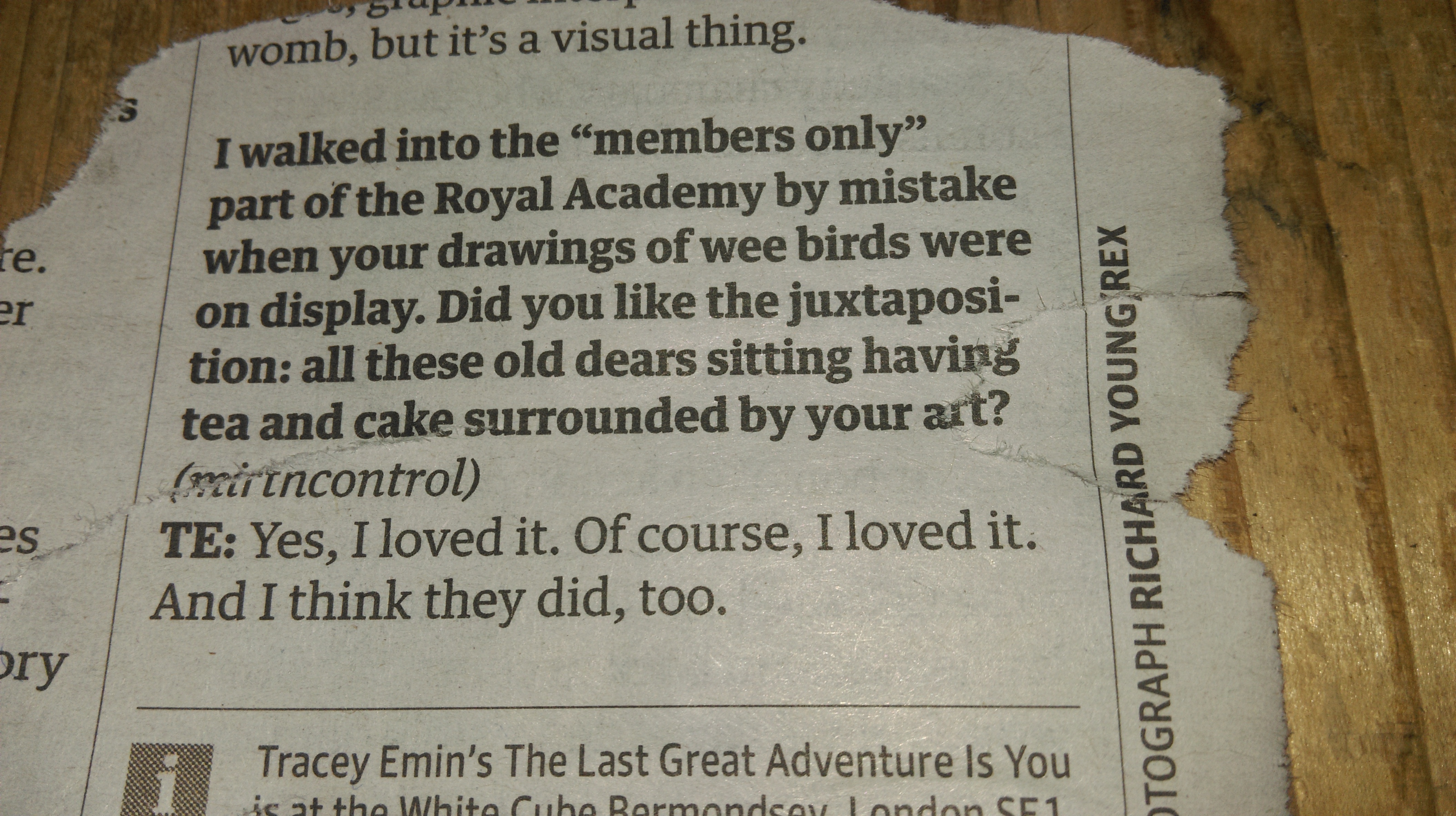
Then I hit 50 and the joke started wearing thin. I deleted the links I’d saved.  I wish I’d kept them, there were some crackers in there which, radicalised by the recent  Age of No Retirement conference  I could send to the #everydayageism campaign, calling out examples of ageism in the media.  I might start by sending them this from yesterday’s Guardian readers’ Q&A with Tracey Emin:
#everydayageism

Why “old dears”? – and why shouldn’t they be within touching distance of a Tracey Emin exhibition?

What’s the brand of the over-50s?

In an advertising-drenched age we are used to weighing-up brands whenever we make a purchase.  What’s the brand image of the over-50s?  What values do you associate with being older? I bet it’s not powerful and dynamic, sexy or daring. And that matters.

“We live in an age where people pity older people and think old women are funny”

commented  one debater in a session at the Age of No Retirement conference. That might explain why 2.9million people between 50 and state pension age are currently out of work in the UK, even though  many of them would love to carry on working – “employers can smell 50”, as one delegate commented, ruefully.

Bring on the language police

Mary Beard was reported recently calling for the word ‘old’ to be reclaimed:

“I think about it in terms of other kinds of reclamations of vocabulary we’ve had over the years, such as ‘black’ or ‘queer”

She has a way to go. I can think of lots of uses of “old”, none positive – old dear, old fart, old fogey, old maid, old codger.  All of them imply staidness – a certain stuck in the mud quality. Doddery-ness.  You don’t think of an innovative old dear, an open-minded old codger, an entrepreneurial old bat.

I think old bag has possibilities.  I like the idea of embracing my inner battle-axe. But if we’re going to establish “old” as a positive thing – or even a neutral one – we may have to think about banning the others.  And while we’re at it, can we do something about some of the other words used about the over-50s?  So, no more “silver” (-surfers or -foxes) and a pox on “sprightly” and “young at heart” .

I’m torn about the use of the word “grey” –  as in “grey pound” or  “grey vote”. Even though grey has been having a bit of a fashion moment recently, it’s hardly a signifier of passion and energy.  Anyway, I don’t spend a grey pound, I spend a shiny gold one, just like everybody else.  But if we are going to start making advertisers think about the over-50s as anything other than Wonga grannies or knitters of Shreddies, perhaps we have to use the power of the “grey” consumer and flex some financial muscle.   £1 in every £5 spent on the high street comes from people over 55 – and there’s good news for marketers, apparently  talking to old people doesn’t have to be scary:

Reassuringly, not everything needs to change when targeting 51-70 year olds – they are not that different to younger consumers. Our research shows older consumers are just as willing to change their views, behaviours, brand, and category choices as younger generations. They are also just as likely to spend money and the drivers behind purchases are similar: 51-70 year olds want the best quality, an acceptable price, and a brand that won’t let them down.

Who’d have thought it?

Internal execution – the language of recruitment

There is a language spoken by recruitment consultants that possibly only they understand.  From this morning’s  jobs bulletin from Timewise:

Salary £50K FTE and excellent benefits.

Our client is a blue chip FMCG organisation, this person will internally, develop and lead all brand marketing strategies from an in-store perspective and externally execute the category and brand strategies in-store.”

Why I Read Fiction

Just back from a great event at the Write Idea Festival in Whitechapel on the subject of whether or not fiction still matters.

A number of people have told me recently that they read less fiction nowadays, diving instead into biography and history and popular science and philosophy.  My husband has an admirably disciplined approach, alternating fiction with non-fiction in strict, not to say slightly obsessive, order.  Me, I rarely read any non-fiction longer than a newspaper feature and don’t feel the need to apologise for it.  I read for comfort and company, entertainment and enlightenment, insight into other cultures; to experiment with experiences I will never have and seek reassurance that  experiences I am having have been shared by other people at  other times.  I read fiction because it has an emotional truth and resonance that I don’t find in non-fiction.  And,  as the panellists in today’s event said, it quite often has a depth and truth that non-fiction can’t rival.

I have, coincidentally just finished reading Penelope Lively‘s How It All Began which is in part about the power of reading.   One of her central characters is a retired English teacher who is teaching a class of new arrivals to London to read English. There’s a wonderful passage in the book in which she reflects on what reading has meant to her.  Too long to quote in full, but here’s a bit:

Charlotte knows herself to ride upon a great sea of words, of language, of stories and situations and information of knowledge, some of which she can summon up, much of which is half lost but is in there somewhere.  She is as much a product of what she has read as of the way she has lived.  She is like millions of others built by books, for whom books are an essential foodstuff, who could starve without.

Me too. And maybe I’m also a bit like Anton, the Polish would-be accountant who goes to Charlotte’s class.  She gets him to persevere with reading by giving him children’s stories to read, luring him in by making him want to find out what happens next.  Sceptical at first, Anton succumbs eventually to the joys of reading Charlotte’s Web on the tube.

  He rattled through the darkness, reading.

Which surely is what we’re all doing. Rattling through the darkness.  Reading.

What do you do when you’re stuck “off assignment”?

It's a tough market out there
It’s a tough market out there

Over the past couple of weeks a rather wonderful discussion thread has been unfurling at LinkedIn (an unexpected sentence I never thought I’d write).

The members of the Interim Managers Group  have been discussing what they do when they’re out of work – stuck “off assignment” .

This is heartening, not just because of the advice they’re sharing (of which more later), but  for the  simple fact that they are publicly acknowledging that even the most experienced interim has periods out of work when no matter how good you are, how expert, how well connected, you still can’t get hired for love nor money.

People rarely feel comfortable owning up to the fact that they’re not as successful/busy/in demand/well-remunerated as they’d like to be.  There’s lots of success shared over the networks of LinkedIn, but very few accounts of troughs to go with the peaks.  Having just finished a period “off assignment” myself, I was particularly cheered by this thread. People tend not to talk about this side of consultancy so it’s perfectly possible to believe that you are the only person who doesn’t move seamlessly from one well-paid assignment to the next. But hey, waddya know, everyone’s in the same boat.  Lots of people – experienced, well-qualified, massively employable people – sometime endure hair-raisingly long gaps between assignments.

Advice from the horse’s mouth

It’s the notion of a shared experience rather than any one piece of practical advice which will be the most help to me next time I’m caught in between jobs. But here’s a digest of practical suggestions for what to do if you’re temporarily without billable work, with thanks to the massed ranks of LinkedIn’s interim managers:

  • Maintain a structure to your day, your week, your month. Set some goals to achieve, work-related or not, and work towards them.
  • Keep your networking fresh, especially during the time you’re in an assignment otherwise your network may see you making contact only when you’re looking for work.
  • Create a business plan every year which will ensure the business is sustainable. Plan in time for personal development and marketing activity.
  • Go to as many industry events as you can to keep your network and industry knowledge up to date.
  • Work on your Linked In profile:
    1- Look at other profiles and see how yours can be improved
    2- Participate in discussions
    3 -Look at your home page every day – use CTRL-F to search for       relevant postings.
  • Email your ISP contacts every 6-8 weeks to remind them you are still looking.
  • Keep the faith – you will find work again.

And here are some tips from a different source on how to stay positive while you’re looking.

The benefits of thinking small

My eye was caught by the pull-quote on a piece in today’s Observer about why so many government IT projects end in digital disaster.

The key is to employ computing firms that think £100,000 is a lot of money and are used to delivering on time.

The writer pinpoints the problems that come when non-techy civil servants are responsible for the procurement of complex government IT projects.  Too often he argues, they opt for the safe choice and bring in the large, established firms who have managed – and failed to deliver – big projects in the past.

What you see is not necessarily what you’ll get

That’s not just a problem for IT contracts – nor is it only an issue in the civil service.  As the project lead on any complicated, big budget contract the safest thing to do, the way to protect yourself if things go wrong,  is hire a recognised name.  As the old saying goes – “no-one ever got fired for hiring IBM“.  But in my experience not only can big companies take a generic,  one size fits all approach to project delivery , they also have a tendency to wheel out the big guns at pitch time, dazzling clients with the lustre of their track record and the expensive cut of their suits, and hand the actual work to an altogether scruffier junior colleague.

The place to be – if you’re a client – is with a company which REALLY values your business, because you represent a significant chunk of their annual income. They won’t palm you off with the newly qualified trainee, they’ll make sure you get the personal attention of the MD.  They’ll know their reputation relies on how well they do, because your project is going to feature in their portfolio in future.  They’ll make sure they hit the deadlines and stick to the budget. And because they probably don’t have expensive overheads (or buy handmade suits), they won’t charge you an arm and a leg every day for the pleasure of their company.