
I filled in an online Yougov survey yesterday about attitudes to owning things versus subscribing to services. Would I prefer to own a car or subscribe to a car share scheme? Buy CDs or sign up to Spotify? Would I consider subscribing to other services – would I fancy a monthly service to deliver socks to my door? How about subscribing to a house-keeping service, or a service to keep an eye on my young children/aged parents (delete as appropriate). Which got me thinking about how much I care about owning stuff. And if I care about some stuff and not about others, what makes the difference?
It took a while to untangle the different things the survey was asking about. Subscribing to a security service makes sense and is an entirely different kettle of fish from signing up to get knickers through the post. The first can’t be replaced by a purchase – what would I buy? My own security guard? The latter seems to me yet another sign of the impending collapse of 21st century civilisation – whaddya mean, if I’m too busy to buy socks I could have them delivered? Who’s so busy they don’t have time to buy socks? How bloody idle are we?
But there are some interesting grey areas, of which books are the most straightforward.
I’ve loved books all of my life and I have thousands. But I buy very few these days, can’t afford to keep up with the pace at which I read, and don’t have any more shelf space. So I don’t go to bookshops much (which is sad), but I do have a well-used library card. Owning the book isn’t important, giving it back when I’ve read it doesn’t bother me. My mother, on the other hand, a Depression-era baby, hated using the library: ownership was important to her and the smell and feel of a new book made her happy.
That was then
I wrote this as a draft post years ago and never used it. The sock service link dates it to 2015. I’ve no idea why I didn’t post it then. I’ve just, sadly, edited the paragraph about my mother to put it into the past tense – she died in 2017. Now it’s a useful test. I had to pay to upgrade this blog to make sure I could still access it, which makes this the most appropriate way of seeing if I’ve re-set it properly. Without the upgrade I couldn’t develop the blog, add much to it, or use what I’ve written since I set it up almost fifteen years ago. Which made me wonder if I ever actually owned any of it at all?
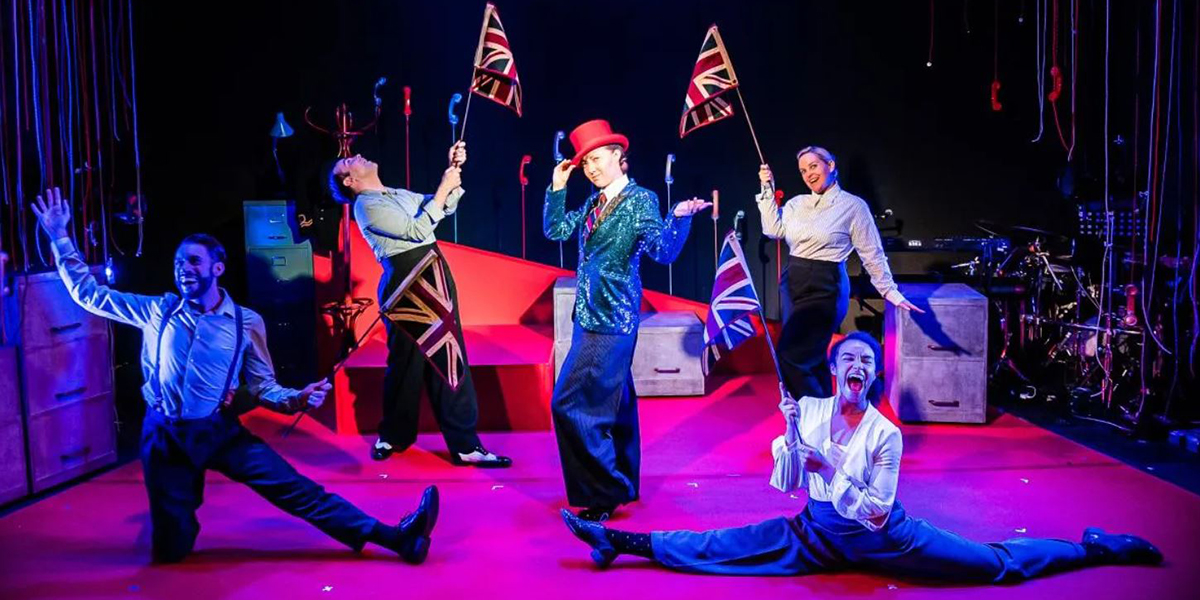
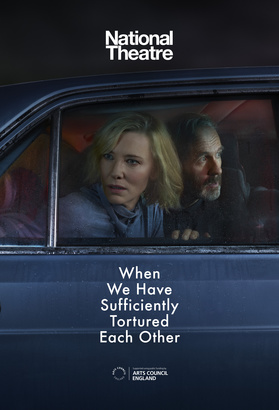 When I got my tickets to see Cate Blanchett and Stephen Dillane in When We Have Sufficiently Tortured Each Other in the National Theatre’s ballot I did ponder whether it was the most romantic thing to take my husband to see on Valentine’s Day. Then I read the reviews and it felt more booby prize than golden ticket.
It’s a terrible play, let’s face it, although there are interesting things in it. Are these two people locked in a marriage or has she been trapped by an abusive abductor? Is he master manipulator or a pathetic inadequate (or both)? Then it becomes clearer (I think) that it’s about the fluidity of the roles people can play in a relationship. Playwright Martin Crimp says it’s about “predator and prey“, but it’s impossible to pin down which is which. It’s saying that women can be dominant and men submissive (and vice versa) when they choose, and both can be a representation of their true nature; that there’s more than one way to be desirable and more than one response to being desired. That occasionally the best way to get over the tedium of who’s turn it is to make the sandwiches is to disappear for some creative play in the garage. Maybe there are clues in the book (though there’s probably less gaffer tape, shaving cream or scenes on the back seat of a four-door family saloon in Samuel Richardson’s original).
The performances from the two leads are great, but it really isn’t a good vehicle to explore anything of substance. It’s not transgressive, it breaks no real taboos, it makes S&M look rather dull (and such hard work – all that fiddling about with maid’s costumes and blond wigs). More than anything it reminded me of this:
As of this lunchtime I no longer have a child in school. After 15 years of book bags and reading practice and PE kit and lunch money and parents’ evenings and INSET days and school reports and grumbling about the price of uniforms, suddenly it’s all over. One is off to university this autumn, the other will be heading for sixth form college, unburdened by the need to put his hands on his school tie ever again.
They’ve changed a lot, of course, in the past 15 years. Possibly not as much as the school system has. Beneficiaries of New Labour’s “education, education, education” largesse they went to an excellent local primary school, and have kept one step ahead of the reformers ever since.
The youngest enjoyed all the sports the local primary sports coordinator introduced him to – shortly before the school sports partnerships which made it possible were abolished. They went to an outstanding secondary school which was in the very last group of schools to be refurbished under the generous old Building Schools for the Future programme. The oldest completed her AS levels in the year before AS’s were changed. The youngest has just done the last year of old-style GCSEs before syllabuses, course work and the grading system itself are all reformed. They leave the school system while uncertainties about possible forced Academisation swirl around. I have occasionally pictured their ride through the school system like a scene in Raiders of the Lost Ark: we are, collectively playing the part of Indiana Jones running just ahead of the granite ball representing the Department for Education – or maybe we’re Bart, they’re Homer:
They’ve done fine, of course, thanks to a series of hard-working, professional, and downright wonderful teachers who cajoled, inspired, and enlightened them all the way and who genuinely seemed to care about what happened to them. And not everything has changed since my day. I asked my son how he felt about leaving. “Now it’s over I can look back on it and say it was great” he said (remember, he left school about two hours ago) “But at the time, when you’re there and you’re a teenager and you hate everything, it makes you feel like banging your head on the desk.” I doubt there’s anyone who went to any school, anywhere, who doesn’t know exactly how that feels.
I’ve been trying and failing to write about the EU referendum campaign from a comms perspective; hoping to make sense of the messages we’re getting, the choices on offer, the strategy and tactics each side are deploying. I’ve given up. There is no logical sense to this campaign which seems to be based on an abandonment of respect for the truth, a descent into scare-mongering and deceit on all sides and racist dog-whistles as blatant as air-raid sirens.
We seem to be in a place where logical argument, respect for the facts, a willingness to listen to another person’s point of view and engage with it seriously no longer play any part. We’re an awfully long way from the last time our membership of Europe was debated:
television broadcasts were used by both campaigns, like party political broadcasts during general elections…. The “Yes” campaign advertisements were thought to be much more effective, showing their speakers listening to and answering people’s concerns
I dug that out the last time we’re were facing a referendum choice Nick Clegg’s ill-fated attempt to reform the voting system. I said then I felt insulted by the low level of debate on offer. Now it feels like the age of Demosthenes (who, the internet tells me, provided the perfect summary of this campaign)
A man is his own easiest dupe, for what he wishes to be true he generally believes to be true
No-one’s mind can have been changed by this debate. Those who hated Europe at the outset have had their prejudices confirmed, so have those of us who see a better future for the UK inside the EU. I’m with Robert Harris:
I don’t think I have ever felt more depressed about the future of the country.
 I started dyeing my hair in 1980. I finished last week.
You always remember the first time. For me it was a trip to the hairdresser designed to make me feel grown up. It ended with aubergine-coloured hair, definitely frowned on by school, which I tried and failed to convince my friends was deliberate. After that I stained my mother’s towels orange with foul-smelling henna for years before turning platinum blonde in about 1989 with a dye job done by a Swiss hairdresser friend of my flatmate’s, who burned my scalp with bleach.
I carried on dyeing my hair long after teen rebellion had ended, and well before the grey set in – copper, blonde, mahogany, russet streaks; strands of hair pulled painfully through the holes in a rubber cap with a crochet hook before the merciful discovery of wrapping hair in twists of foil. The hairdresser’s chair was one place I felt that I could play around with my appearance in a way which didn’t involve the miseries of clothes shopping (I am not a standard shop-size: shorter than average, broader of back, larger of chest. Things are slightly better now, but trips to buy clothes always seemed to end in accepting the things I could fit into rather than anything I might actually want to wear and a consolation trip to a bookshop to cheer myself up. At least your hair always fits).
During the child-care years, the hairdresser represented a couple of hours’ peace and quiet, a link back to my pre-motherhood life where I could read a magazine without interruption and someone else made the coffee. More recently it’s become a chore. As the grey advances it feels like a necessity not a pleasure; maintaining the pretence that I’m not getting older, out of a fear that older means past it.
It’s a jolly expensive pretence though. I have my hair cut every couple of months. At London salon prices, a cut and colour six times a year runs into many hundreds of pounds, which frankly at the moment I can’t afford, and which has become one more damn thing to worry about.
 And it’s not just the cost I care about. I’ve been quite strident about the evils of ageism, so what does it say about me that I can’t bear to display a public sign that I’m not 35 any more? The cut is important, I think, to show that it’s a considered choice not just a grand abandonment of caring. The cut I have now isn’t right, so I’ll be heading back to the hairdressers soon to get it shorter, sharper, chic-er. But I won’t be asking them about the colour. By the end of the summer I’ll be grey. I can put the money I save towards some new clothes (or maybe some books…)
I was bemused that The Guardian published its guide to university open days today. Aren’t most of them over? We’ve spent the summer trailing from hall of residence to library to lecture theatre up and down the country. I’m quite good at it now – so here, in no particular order, are things to remember when it’s my son’s turn:
The challenge for university communications departments
All five of the universities we’ve visited offer great courses and opportunities to study abroad. They all have active student unions with more scope to sing/dance/play sport/climb mountains/be political or play tiddlywinks than one person could realistically fit into a lifetime. They have broadly similar accommodation, costing roughly the same amount per week. What they offered was, frankly, much of a muchness. Small differences in presentation take on huge significance when that’s what separates one from another. A cry of “this website is RUBBISH” from my daughter, meant that the university in question had some catching-up to do when we got there. A good website is essential; apps are de rigueur; maps need to be helpful to people with no sense of direction (ahem).
Enjoy it
More than anything else it’s been a joy to spend uninterrupted time with my daughter and realise again what good company she is. Some of her friends started their university careers this week. I’m both looking forward to and dreading her making the move next year. But at least now I know that, wherever she goes, we’ve researched the hell out of the kitchen arrangements.
“Now I don’t have children any more…” I found myself saying to an old friend this afternoon. Until she brought me up short by reminding me that, yes, actually, I still do.
And of course I do. Two delightful, charming, intelligent, beautiful, talented, beloved children. I was mortified to have said such a thing. I am writing this as an attempt to assuage the guilt of even temporarily denying their existence.
Except, I also, sort of don’t have children any more.
I didn’t have to dash home from meeting Louise to pick them up from school. I can, for the first time in years, make plans that aren’t dependent on finding a responsible adult to look after them until Richard or I can make it home.
There are times when I really miss the having of children; the privilege of being absolutely at the centre of someone else’s life. And I love (almost) every minute I spend in their company. But I do have to say, emerging on the other side of the babysitting years has its advantages too.

Just back from a great event at the Write Idea Festival in Whitechapel on the subject of whether or not fiction still matters.
A number of people have told me recently that they read less fiction nowadays, diving instead into biography and history and popular science and philosophy. My husband has an admirably disciplined approach, alternating fiction with non-fiction in strict, not to say slightly obsessive, order. Me, I rarely read any non-fiction longer than a newspaper feature and don’t feel the need to apologise for it. I read for comfort and company, entertainment and enlightenment, insight into other cultures; to experiment with experiences I will never have and seek reassurance that experiences I am having have been shared by other people at other times. I read fiction because it has an emotional truth and resonance that I don’t find in non-fiction. And, as the panellists in today’s event said, it quite often has a depth and truth that non-fiction can’t rival.
I have, coincidentally just finished reading Penelope Lively‘s How It All Began which is in part about the power of reading. One of her central characters is a retired English teacher who is teaching a class of new arrivals to London to read English. There’s a wonderful passage in the book in which she reflects on what reading has meant to her. Too long to quote in full, but here’s a bit:
Charlotte knows herself to ride upon a great sea of words, of language, of stories and situations and information of knowledge, some of which she can summon up, much of which is half lost but is in there somewhere. She is as much a product of what she has read as of the way she has lived. She is like millions of others built by books, for whom books are an essential foodstuff, who could starve without.
Me too. And maybe I’m also a bit like Anton, the Polish would-be accountant who goes to Charlotte’s class. She gets him to persevere with reading by giving him children’s stories to read, luring him in by making him want to find out what happens next. Sceptical at first, Anton succumbs eventually to the joys of reading Charlotte’s Web on the tube.
He rattled through the darkness, reading.
Which surely is what we’re all doing. Rattling through the darkness. Reading.

I lose count of the spam emails I get every day, enticing me to click on suppurating links so that they can ooze viruses all over my hard-drive, or phishing for bank details so that they can take a crack at my account.
I was called this weekend by Argos credit department to double-check that I had actually applied for a credit card with them (I hadn’t) and really did want to buy a new telly (nope). That call came a few days after my husband had a letter from another credit company thanking him for opening his new account and wishing him happy shopping (that was fraud too). There is – be warned – currently a spate of fraudsters lifting contact details from entries at Companies House and using them to get unauthorised credit. (You can, by the way protect your file at CH with their PROOF service)
I hate answering the land line these days because the only people who ring it are cold-callers trying to interest me in buying a time-share or rook me out of compensation for mis-sold PPI. And I’m bloody sick of it. Sick and tired of the whole chiselling, weaselling, cheating, swindling, thieving, fiddling, diddling, shyster pack of them. Tired of being treated like a know-nothing no-mark whose money is up for grabs by any fraudster who fancies dipping a hand into my pockets. A pox on them all.
Like Peter Finch in Network, I’m mad as hell and I’m not going to take it any more. Except of course I am. Because seemingly the only way to stay completely untouched is to get off email all together, revert to writing letters and hope that clients will appreciate a slower and more contemplative service.
 Sole Trader PR