#Meh2AV – dumb and dumber go campaigning

There are just a couple of weeks to go before the end of the campaign but I still can’t quite make up my mind.  What has been the worst piece of political campaign material in the AV debate so far?

I thought No had the edge in irrelevant stupidity with the “This baby needs an incubator not an alternative voting system” ads.  Then I saw the  Yes TV ad which has MPs running scared while people yell at them through megaphones.

Both sides are taking part in the customary celebrity arms race – Yes has royalty in the shape of Colin Firth and Helena Bonham CarterNo seems to have bagged Peter Stringfellow (hmm).   The best comment I’ve seen so far on this game of Celebrity Top Trumps was  Armando Iannucci’s:

Loads of celebs in AV debate. If YES wins you get Eddie Izzard, NO gets Rik Mayall. As a 3rd rate celeb, I’ll hold the balance of power
 
No  seems to have the edge in playing the man not the ball (vote No because Nick Clegg wants you to vote Yes.  Vote No because otherwise the BNP will get elected – even though there’s IPPR research to suggest they won’t ).
Yes is pinning its hopes on the fact that we are so disgusted with “our broken political system”  that we want to punish MPs by changing the way they’re elected.
What we’re missing is a sign that anyone connected with either campaign is thinking about anything other than slinging mud at the other guys.  Is anyone analysing what the audience might actually want or need to know before they decide to change – or not change – the voting system?  Because  if they are it’s not showing out here in the real world.
There are few precedents for how to campaign in a referendum when political parties are split.  The obvious one is the  1975 referendum on membership of the EC. I don’t remember it myself,  so I looked it up to see what campaigning was like back in communication’s dark age:
Television broadcasts were used by both campaigns, like party political broadcasts during general elections. They were broadcast simultaneously on all three terrestrial channels: BBC 1, BBC 2 and ITV. They attracted audiences of up to 20 million viewers. The “Yes” campaign advertisements were thought to be much more effective, showing their speakers listening to and answering people’s concerns, while the “No” campaign’s broadcasts featured speakers reading from an autocue
 
Listening to and answering people’s concerns, eh?  What will they think of next…   They had really informative (though extremely long) leaflets about the issues too.
AV is a classic example of a campaign that no-one wanted or believes in.  The No-s think it’s a sop to the Lib Dems to keep them onside in the Coalition.  The Yes-es really want to be talking about PR.  And it really shows.  It’s not just that I feel personally insulted by their rock-bottom estimation of my intelligence.  I also feel professionally ashamed of the woefully low level of  comms skills on display.
No wonder it’s been estimated that voter-turnout where there are no local elections could be as low as 20%.  Electoral reform is always going to be a tough comms sell. But what a wasted opportunity to have a grown-up debate.
Marching up and down again

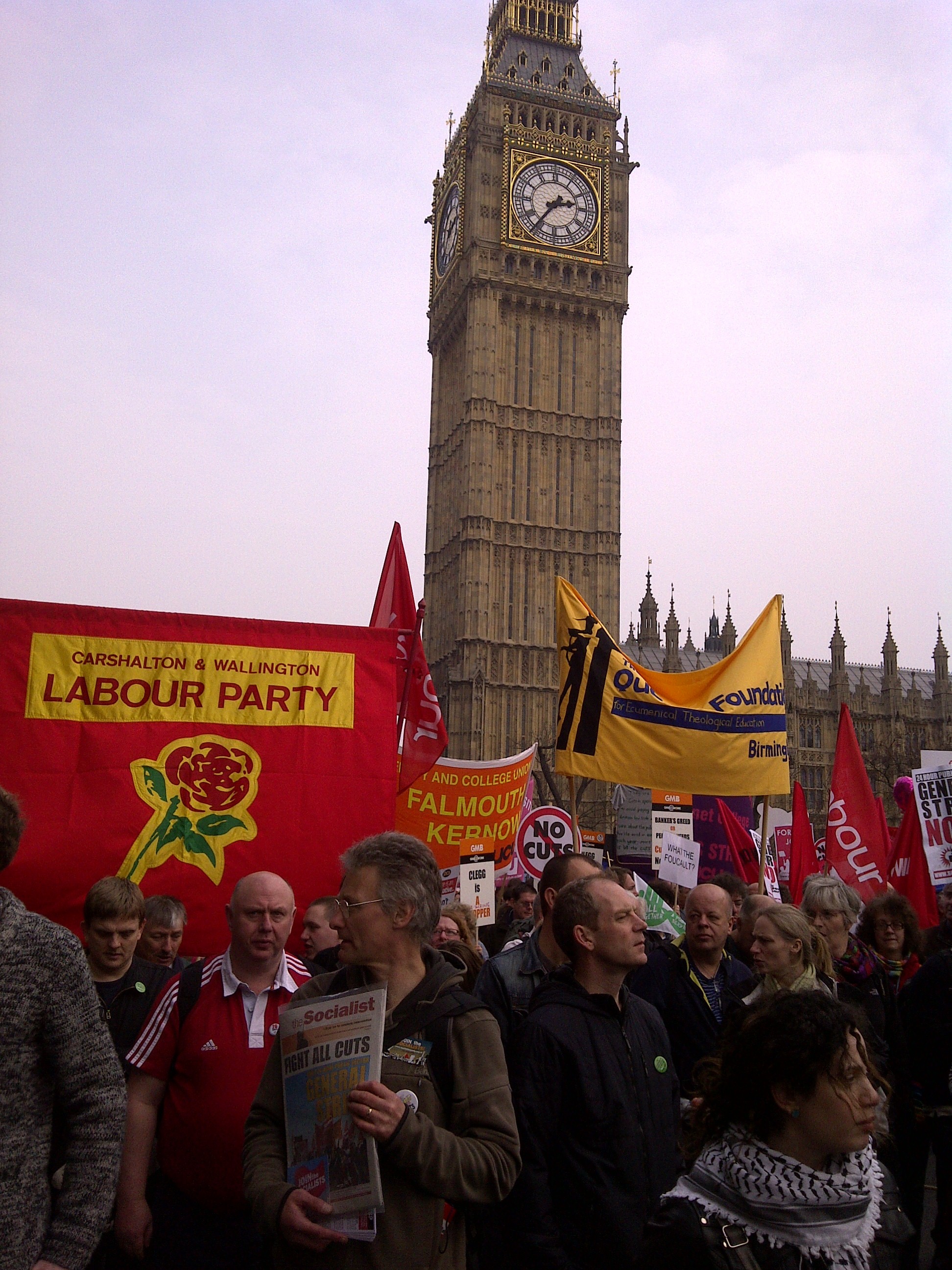
I didn’t demonstrate about anything until I went to university and experienced the joy of yelling “Coal Not Dole” at bemused Saturday morning shoppers.  I was one of hundreds of nicely brought up, middle class kids who’d never been anywhere near a coalfield but liked the frisson of shouting loudly in public and the certainty that “we” were on the side of right and “they” would have to listen to us.

My political understanding has got a lot more sophisticated since then, and my expectation that marching achieves anything has lessened considerably, but I still find it moving to be part of a crowd of people, making a point by the simple act of coming together.

My 13-year-old daughter is years ahead of me as a marcher – she was already a veteran of two anti-cuts demos before she joined me at the TUC march to Hyde Park yesterday.  (If nothing else, the government is doing an excellent job of politicising young people.)  And she, like me, thought it was great.

I burst out  laughing when, under the bridge by Embankment station, a brass band started playing and the crowd started to dance.  She chanted  along to all of the most scabrous political slogans (I’m telling myself that she doesn’t know what some of those words mean…) I’m glad I went and I’m glad she did too, even though it means she’s likely to be disillusioned about marching early on in her protesting career: the wrangling about how many people were there  (“at LEAST 500,000” according to her – half that according to the papers); the fact that a handful of idiot protesters whose actions are endlessly looped on the news can become the way that an event is remembered.

Having tweeted that everything was calm and peaceful on the route, I was called a muppet and a moron for not realising that the event was actually a hotbed of rioting anarchists throwing ammonia-filled lightbulbs.  “Take your blinkers off” I was urged by someone apparently watching events from his sofa, in between following the England – Wales game on TV.

Rebecca insists the whole thing was worthwhile:   “It was really good and the 100-odd idiots that decided to throw paintbombs, missiles and fireworks at people completely hijacked the entire march and took it away from us.”

I agree with her – though I also agree with the man quoted in today’s papers: “I think this march is a pretty futile gesture.  I don’t think politicians respond to protests.  But sometimes futile gestures need to be made and there’s comfort in being with other people who feel the same way.”

There’s been lots of nonsense spoken about yesterday – quite a lot of it by the marchers themselves (however cute the March Like An Egyptian placards looked, this is not Egypt.  Cameron is not a Mubarak-style dictator.  Trafalgar Square is not Tahrir Square.  The news story about Libyan woman Iman al-Obeidi in today’s papers should highlight how ridiculous those comparisons are) It was just a heartening  example of people standing up to be counted for something they feel is important, and that in itself is something to celebrate.

Is government communications more than press relations?

I was badly sidetracked from what I’m meant to be doing today by a podcast of an event from the Institute for Government What Next For Number 10 Communications? Inevitably the  focus of the event  –   “the role of the Number 10 Director of Communications” – was about press relations.  A distinguished panel of former prime ministerial press advisers and senior journalists was assembled to talk about the role facing Craig Oliver, David Cameron’s new Director of Communications.  It was a fascinating insight into the trials and tribulations of a press handler’s life.  But it did leave the impression that the only kind of comms that matters in government is press relations.

For anyone who’s worked in any other comms discipline in government this will sound familiar if dispiriting.  For understandable reasons most Ministers are focused most of the time on how they are going down in the press.  Other comms approaches don’t seem to have the same resonance with them – even though they might offer more effective ways of communicating directly with the public.

Meanwhile, the review of government comms chugs along, and is due to report soon; and the current Head of COI,  has just announced that he’s leaving for pastures new, giving some the impression that COI’s days as a significant player in government comms may be numbered.

I raised some of the questions I’d like to see answered in the comms review  here.  In particular there are big issues to be addressed around the potential of  new media approaches in government comms.  The only question  I heard raised at the IoG’s event about the role of the internet  (by the only woman’s voice I heard at the entire event) wasn’t answered  by the assembled gentlemen of the press (which chairman Nick Robinson described, without apparent irony, as “a cosy Radio 4 reunion”).   Perhaps my Twitter hero, Sir Bonar Neville-Kingdom  “HMG’s data sharing Czar”, is closer to the truth of the government’s approach than I’d  imagined (sample tweet:  We could use the Internet to allow people to connect directly to Whitehall, like a sort of Departmental Ceefax, via wires as it were.)  Can I put in a request to the IoG that now they’ve looked at issues of the press they could turn their attention to the other forms of government communication and debate them?  I’d go.

Government comms – cock-up or conspiracy?

I’m amused that people are claiming to see dirty tricks afoot in the government’s climb down on the forestry sell-off.  There was a round of applause when it was suggested on last night’s Question Time that the whole thing was a set-up to present the government in a caring and listening light and to deflect attention from more nefarious goings on in health and education.

Having worked in Whitehall, I’m always amazed that people think government is efficient enough to put a conspiracy together.  Given the choice between something being down to cock-up or conspiracy I would bet the mortgage on it being a cock-up every time.  Government is too big, leaky, dumb and chaotic to manage the nimble footwork, discipline and cunning required to manage a conspiracy,   it certainly couldn’t raise the wherewithal to do it over this.  The simplest explanation is the best – they messed it up, didn’t listen to anyone before they announced the policy, hadn’t thought through the politics of it and were astonished at the response.  Another one to chalk up to my growing list of examples of how bad government comms is at the moment.

Perhaps David Cameron’s past life as a PR came to his aid when he killed the policy.  Standard advice  in crisis comms  is to act swiftly and decisively, accept blame where it’s due, put counter-measures in place fast and apologise sincerely.  All of which they more or less achieved.  I do wonder about the longer term damage to the Tories’ corporate reputation, though.  Ed Miliband has already made the point that cuts are reviving memories of Thatcher and “re-contaminating” the Tory brand.   At least the Thatcher governments maintained a reputation for being steadfast in the face of opposition. How many more U-turns driven by poor policy planning  can this lot afford before their public image is of malign but incompetent toffs blundering through things they don’t understand?

How many poll taxes fit into an area the size of Wales?

There are many shorthand measures used by newspapers to indicate size: Wales for geographical area, Wembley for crowds, swimming pools for volume, Nelson’s column for height, double-decker buses for dinosaurs (a rather specialised subset).  There seems to also be one newspaper measure for showing just how big a problem a politician has got himself into: the Poll Tax.

For Blair, ID cards, university top up fees and inevitably Iraq all got the “Is this Blair’s Poll Tax?” treatment.

Gordon Brown had fewer Poll Tax moments – perhaps he just had less time to stumble into them, although Polly Toynbee was worried that it might be the Tube.

For David Cameron, overwhelmingly it’s NHS reform, although Socialist Worker wants it to be tuition fees,   Labour Uncut feels it could be the housing crisis  and the TUC is warning about the whole package of cuts.

How young do you have to be before the Poll Tax ceases to be meaningful as something which happened during your political lifetime and becomes something that has to be set into context – in the same way that I had to have  Suez explained when it was the standard measure for British humiliations in world affairs (I grew up in the 1970s, there were LOTS of those).

The Poll Tax riot was in 1990.  Thousands of people who voted in the general election  weren’t born when it kicked off.  Does it mean anything to them or is it time for the hacks to stop being lazy?

Update:  Just checked, following today’s Big Society-debacle headlines.  No-one has actually called the BS David Cameron’s Poll Tax – yet.  The WSJ has already described the Big Soc as “the silliest idea to have come out of the party since the Poll Tax” so it’s probably only a matter of time.

Big Society – what next?

The news that Liverpool is pulling out of a Big Society pilot project, blaming cuts and central government inaction, was met with a certain amount of grim satisfaction yesterday.  It seemed like vindication for those who’ve been arguing that the Big Soc is incompatible with the cuts affecting the voluntary sector.    The announcement that Big Society head honcho, Nat Wei is cutting down on his voluntary hours because he needs time to earn a living got a similar response.  People are lining up to say “I told you so” about the  failure of the Big Society (look, I can do it too) without being able to offer an alternative vision of how to provide public services  at a time of swingeing cuts (no, I haven’t got one either).

The Big Soc has always been hampered by its supporters’ inability to explain how it would actually work.  The best summary I’ve heard of the problems with the BS was provided by Anna Coote from NEF at an RSA event at which the audience lined up to condemn the flakiness of the idea – and, if memory serves, the BS defender talked about the importance of people talking to each other on buses.  In the absence of a convincing narrative about how the Big Soc would work in real communities with serious problems, it’s been too easy for its opponents to paint it as a fig leaf for cuts.  (As one respondent to a  Third Sector/LGC survey of attitudes to the BS said “It might work in Ambridge, but not in the real world”)

So, we’re all agreed.  It was a difficult idea raising lots of practical problems, and it’s not going down well.  Rather than carping, though,  I’m intrigued by what happens next.  Given that the Tories aren’t going to change their minds and release more funds to support services, how are they to be delivered in future?  There’s obviously a role for public, private and third sectors to work together – how is that to be done?  Does it matter if it’s done differently in different locations (the chaos that Nicholas Boles said he would welcome in place of central planning)? Can a practical structure now be hung onto the smaller government/bigger communities/locally driven  idea, which many people find appealing when it’s explained properly.  What’s the transition plan?  If the objective is to get from central planning/central funding to locally provided, tailored services,  how do we get from A to B without decimating services en route?  Is the government completely the wrong institution to be driving this at all (a point made in CIPRtv’s examination of communications issues around the Big Society)?  And (another opportunity for me to say I told you so), how come the comms around this central plank of government policy has been handled so very badly that almost no-one seems to understand what the Big Society is all about?

Missing the Minister’s box

I had the unusual sensation of feeling sorry for Nick Clegg when I caught up with the Sunday Telegraph’s story about his refusal to accept new business via the red box after 3pm.

For the record, this does not mean that he is knocking off early to have a game of frisbee in St James’s Park with Miriam and the kids.  It means that if a civil servant wants him to respond to a query or approve a decision, the paperwork has to be  with Private Office by 3pm – else it will have to wait til the next day. That’s all.  The stuff in the box is  what gets taken home to be ploughed through at night, once the day’s meetings have been done.  Box times are just a signpost for officials, they have nothing to do with how Ministers spend their days.   There are, in any case, very few decisions in Whitehall which absolutely MUST be taken within 24 hours (whatever civil servants think), and I’m sure that if Clegg’s private office felt they had one of those on their hands after the 3pm deadline they’d find a way of getting in touch with him about it.

Oh, and far from it being unprecedented to close the box early, Ruth Kelly did the same when she was at DfES.  Her deadline was 4.30, I seem to remember.  It caused the odd raised eyebrow at the time, but the Department didn’t spin wildly out of control as a result.

Now, presumably the Telegraph knows all this.  So why are they gunning for the Deputy Prime Minister?

Foopball, foopball, ra, ra, ra

In the wake of the coverage of Andy Gray/Richard Keys, I had  a blog post floating round my head yesterday about the  crushing ubiquity of football and the culture that surrounds it.    Had I got round to writing it,  it would have made some of the points made by Catherine Bennett  in her piece for today’s Observer Forget getting rid of sexism in sport.  Let’s get rid of sport:  an end to the blokey horror if it all, say I, to the absolute  inescapableness of it, to the obscenity of the money (pretty much any story in the Observer’s Said and Done column most weeks is enough to make you want to ban the game completely), to the new social necessity of following a team.

I blame Rupert Murdoch, for enabling the Topsy-ish growth of the Premier League, and Nick Hornby , whose   Fever Pitch made it socially acceptable for football to spread beyond the back pages, wheedling its way into every part of daily life like honey fungus.

Bennett makes another good point in her piece about the pervasiveness of sports chatter in the media: the low percentage of women and girls who enjoy the competitive nature of team games:

the Women’s Sports and Fitness Foundation finds that 36% of women “enjoy the competitiveness of sport”, as opposed to 61% of men. Why, then… should the sport-averse be subjected to extended sessions of compulsory sport, as if they were still in class, forced out into the mud to contemplate the skills of the school elite?

Good point.  And why, if this is the case, are the government so keen to promote competitive sport in schools at the same time as they cut School Sports Partnerships to the detriment of sports that girls might actually enjoy?  I played lots of competitive sport at school – netball, hockey, rounders for the school, a county trial for hockey.  All at the point of my PE teacher’s gun.  I hated every minute and gave up sport as soon as I could, only to rediscover the pleasures of exercise years later when – by then pretty unfit – I joined a gym.

Professional sport is entertaining enough to watch,  but it isn’t important.  I do  not feel it will be a national disgrace if “our medal tally” is worse at the London Olympics than it was in Beijing.  I do not care that ‘we’ are unlikely to win the World Cup again in my lifetime.  I was delighted about the Ashes, but no-one would have died if England had lost.  Sport, like most other things in life, is more fun to do yourself than watch someone else do.   Can we get a bit of perspective back please?

Come on down for Opportunity Costs!

I’d missed the news that Michael Gove  banned the use of the phrase Every Child Matters at the Dept for Education until this week.   This is what you get if you try to find the old ECM site online.

For the record, ECM was set up after the Laming enquiry into the death of Victoria Climbie.  It tried to integrate children’s services, closing the gaps between services previously offered in isolation by schools,  social services and the NHS.  It included the expansion of Sure Start and major changes to the way that local authority services were provided.  It was, depending on your political tastes, either a hugely bureaucratic, over-engineered response to a problem which needed a simpler approach; or an ambitious attempt to address systemic problems in services which  left  young people at risk.  I applauded the intentions of ECM even as it drove me temporarily insane.

I worked on the comms  strategy at the beginning of the programme, addressing audiences in every branch of the public sector,  trying to change the way thousands of people worked.  Our approach was to try to work in partnership with the people who delivered services.  It made sense to us to have the people who were going to make the policy work in practice help shape it – the “if you want to go fast, travel alone; if you want to go far, travel in a group” philosophy.

The pace of progress at the start drove me nuts.  My old boss likened the endless trail of seminars and discussion documents and presentations to bushtucker trials, in which we had to eat our diet of toasted kangaroo balls and cockroach biscuits in order to win the opportunity to come back and do it all again next week.  Eventually, despondent at the rate of progress, I moved on to other things.  It’s taken me  years to realise that my expectation of a faster pace to such massive change was unrealistic.

All those hours of work,  the cost of making change happen so that services would be better in the long run, are now being written off – and I doubt figure  in the government’s balance sheet of the savings they are claiming from slimmed-down public services.

A GP taking part in PM‘s debate about health service reforms made the same point to Andrew Lansley this week, asking whether the costs of redundancies, retraining  and waste due to the scrapping of systems figured in his costs for NHS reform :  “I’ve been around for a long time and I’ve seen many reorganisations, and one of the problems is that there doesn’t seem to be any publication of the true costs of these reorganisations, which often take a couple of years to take effect…”    Lansley argued, as ministers always do, that this time the reform was for keeps, so the costs would be cancelled out in the long run.  I wonder.

I also wonder about the government’s approach to working with partners.  They give the impression of wanting to go very fast indeed and opting to do it solo.  The last post highlighted the apparent state of relations between DCLG and local government.  DoH seems to be working in the face of opposition from its key stakeholders too (though I’m not inside the Department so don’t know what conversations are taking place.)  As the Observer’s secret civil servant pointed out in today’s paper, this may have far-reaching consequences:

Doctors have raised the tempo of the debate and, unlike teachers or policemen, they can comfortably play politics as public deference to medical professionals is strong. Government advisers are not alarmed. The coalition can win this fight. It will pass its health bill in the House of Commons and should get it through the Lords. The new health system will get built but the real risk is what happens then. If doctors are alienated and angry and patients worried and confused, the system won’t work. … Ultimately, this mess may even lose the coalition the next election” 

Irretrievable breakdown or intolerable cruelty?

The link between local and central government is currently providing the best soap opera  in politics.  It’s also offering a case study of what happens when a government’s relationships with one of its key stakeholders disintegrates.

In the face of sizeable cuts in funding for local government, bloggers and tweeters are lining up on the Local Authorities’ side, despairing of the way cuts are being handled.  Arguing that relations between local and central government have never been so bad, LibDem Council Leader, Richard Kemp,  has likened Secretary of State Eric Pickles and his sidekick, Grant Shapps, to Laurel and Hardy; called for Pickles to be sacked and, according to his blog,  written to the new non-exec director on the DCLG board to request that she investigate “school boy howlers” being made at the Department.  Normally mild-mannered members of the LGA are said to be enraged by the repetition of the argument that frontline services can be saved if overpaid council leaders take pay cuts and hack away at back office staff.  The Mayor of Middlesbrough has accused Pickles of refusing to listen to those with experience on the ground when it comes to funding.  (Eric certainly doesn’t give the sense of a man who feels the need to listen.  In size, accent and attitude he reminds me of Charles Laughton in Hobson’s Choice:  “take that or none”.)

The jockeying for position is, of course highly political and despite protestations that power is being devolved to a local level, it reveals how much is being held at the centre.

The LGiU blog has suggested that the recent spat about bin collections was a shot across councils’ bows to remind them who’s boss.   The Spectator argues that Pickles has bigger fish to fry:   “Communities are being empowered; councillors are not.  Pickles has introduced a radical agenda on which the dust will take time to settle. The Bill’s political genius is to devolve responsibility and enforce cuts without relinquishing financial control.”

What’s clear is that neither side are making much of a fist of hiding their animosity.  Lambeth and Camden councils are blaming the government for the cuts as they consult locally to decide which services will go.   Pickles is arguing that wasteful local government is to blame for the UK’s budget deficit.  For a non-combatant the entertainment value is terrific – as long as you can ignore the potential outcome of the cuts.  Government’s relations with such a major partner can’t have been as bad as this since the days when then-Education Secretary David Blunkett was trapped in a cupboard by demonstrators at the NUT’s conference.  How long will it take for a proper working relationship to be re-established?