Getting them out for the lads

I hadn’t really bothered about the 40th birthday of Page 3 this month, other than to notice the irony that it shares its anniversary week with the anti-Miss World demo at the Albert Hall.  Then I was roused to tooth-grinding fury by, of all things,  the  Guardian media podcast  which carried an item about how much of a non-issue Page 3 is these days.  Explaining why, the (female) contributor commented “we’re so immune to pictures that are worse, that Page 3 becomes quite tame and quite funny… the fact that it’s so ubiquitous …you become immune to things you see on such a regular basis.  Familiarity breeds, umm, in this case, lethargy”

Well, no.  Contempt.  That’s what familiarity traditionally breeds.  Contempt.  Which is what Page 3 does.  And, pardon me for pointing it out, but it was to  try and prevent the “worse” images  that Clare Short and others tried to ban Page 3 in the first place.

Page 3 – not uniquely, but it’s a useful general  signifier for porn-lite – is a means of portraying women as objects.  It sends a message that we are the sum of our cup size; that we are perpetually available and up for a laugh (and if we don’t get the joke we must be repressed,ugly killjoys); that we might not be too bright, but it’s OK if we can fill out a g-string; that we’re fulfilled as the recipients of a male gaze.  It’s indicative of an attitude to women that makes (some) men feel at liberty to harass us in the street, and  (s0me) women argue that they are “empowered” by appearing naked in public.  That’s not empowerment, ladies, that’s Stockholm Syndrome.

I don’t know any women who don’t have stories to tell about being shouted at, leered over, groped and worse by men in public places.  Some stories are  frightening, some are just ridiculous.  My friend Laura was once approached by a complete stranger at a railway station who asked her for a date, his eyes never leaving her chest.  She had to point out to him the 9-months pregnant bump that was nestling beneath it.

One of the great blessings of the cloak of invisibility that drops over you when you reach about 35, is that men don’t shout at you in the street any more.  I no longer have to go out of my way to avoid walking past building sites and I miss it not one bit.   So I was really saddened when I was walking Rebecca home from a friend’s house the other night and we were cat-called.  I say “we”.  Neither of  us believed for a moment it was aimed at me.  She’s 12.  She was as angry, puzzled and embarrassed as I always was when it happened to me. I have no idea what to tell her to do about it, other than try to laugh it off.  And start a campaign to ban Page 3.
Acting your age

I’m struggling to help my daughter, who has asked to borrow some clothes so she can dress up “like a 45-year old” for a play she’s doing.  Unfortunately for her I have no idea what “45-year olds” look like .  Personally  I live my non-working life in jeans.  Rebecca is still only 12 but is already as tall as me and has the same size feet.  She borrows my clothes pretty regularly – not the formal stuff, but certainly the  black V-necks and  the ankle boots;  I’ll have to wrestle my trenchcoat off her back if I ever want to wear it again.  So I should just have  drawled “honey – this is what 45 looks like” and told her to go dressed as she was, just adding a  harassed expression and perhaps some crow’s feet.

But that’s obviously not what they want.  I suspect they’re after the look that middle-aged women had when I was little.  In my memory* women then had hair that was styled and set once a week and wore headscarves to protect it in high winds.  They had sensible clothes in muted colours; perhaps a jaunty scarf at the neck.  They wore flat shoes and 40 denier American Tan tights.  Slacks were acceptable but not jeans.   They did NOT have tattoos.  When they got a bit older they wore fur-lined bootees in winter and hats like mushrooms with stalks coming out of the top, and generally looked like the three Great Aunts from Glossop in I Didn’t Know You Cared.

There are no women like that around any more, and I for one miss them.  I envy their domestic competence and their unshakeable self-confidence.  Which is not to say that I want to be like them.  Possibly it’s  the dread of damart that makes women of my generation fear getting old so much (and may explain their sales slogan – Think you know damart? Think again!)  When you pass 40, you are super-sensitive to how very OLD it sounds.   I shuddered when I read a newspaper article the other day about a “sprightly 50-year old”  Sprightly?  Isn’t that how you describe octagenarian ballroom dancers who like the occasional Scotch?

Ageing is unavoidable of course, but I’m still waiting for the level of  grown-upness  in my head to match the number on my birth certificate. And, on a more serious level, I am reminded every day in dozens of little ways – this is only one example – that in the eyes of many people I’m very nearly past it.

*It was surprisingly hard to find images to illustrate this.  There are some very odd things lurking under a search for images of older women, but nothing much that gives you pictures of “ordinary” middle-aged women from the past.  Perhaps they were invisible?

On being in my sub-prime

Or, 5 steps to make yourself feel middle-aged:

1.  Take impossibly glamorous 12-year old daughter clothes shopping.  Hear your mother’s voice coming out of your mouth as you  ask if it’s big enough/long enough/warm enough/waterproof enough and with enough pockets to be worth buying?

2.  Remember with a pang exactly how those questions made you feel when you were that age (if not – ever – that glamorous), and know you should save your breath.

3. Watch the pity in her eyes as she  answers, politely, that it’s fine.  Know that it could be tight enough to cut off circulation and flimsy enough to disintegrate in a thick fog but she’d still want you to buy it.

4.  Realise that the chap on the cash desk who was flirting outrageously with the leggy 19-year olds in front is calling you Madam.

5.  Pay up like a lamb.  Go home.  Water tomatoes.

Men, boys and washing machines

I was commenting on this  post about introducing boys  to the concept of housework without  nagging or bribery when I realised that my comment was longer than the post so I brought it over here.  Do go there (when you’ve read this)  – it’s a site I really like.

Our children have  had chores to do  since they were old enough to do them – washing up, laying and clearing tables, nothing extreme. My daughter does the ironing for a bit of extra pocket money.  My son has been known to clean shoes.  It sometimes feels a bit Dickensian round here, with one covered in boot polish and the other up to her elbows in  suds, but at least they appreciate that the house doesn’t run itself, even though they complain bitterly about tidying their rooms.  I wish my parents had done the same, then perhaps I wouldn’t be so domestically useless.  Thank god I married a man who can cook.

I was struck by the fact that there’s little mention of fathers in the original post,  other than a comment from another reader that men won’t help because they don’t  see housework as their responsibility.   (So, shrug, what can you do?)  The idea that boys’ attitudes to women and housework are up to us and we can’t expect any help from our partners  is incredibly depressing.  It infantilises men and dooms us to a role as perpetual mummies.  More importantly it  means nothing ever changes.

I met up with a friend the other day who’s just finished one contract and is stitching together bits of work to make ends meet while he looks for the next one.  His wife works full-time so he’s  in charge of housework and childcare.  He’s developed a better relationship with their son, a mother-in-law-approved technique for cleaning the loo and a local network of other fathers picking up children at the school gate, presumably there for the same reason that he is. He may have a stereotypically male  attitude to housework – best gadgets researched, new products scientifically compared, time and motion studies on the optimum time to Hoover the stairs – but he’s getting it done and  his son is watching…

Maybe this could be a welcome spin-off from  new ways of working – or an unexpected  silver lining to the recession. When the  norm is either parent at home for part or all of the week – unemployed, self-employed, flexibly working in virtual offices – while the other is at work, perhaps cleaning the bath will cease to be a gender issue and start being something that just gets done.  To speed the revolution along in the meantime, teach your sons to wash their own clothes.  Their future girlfriends will thank you.  They might too.

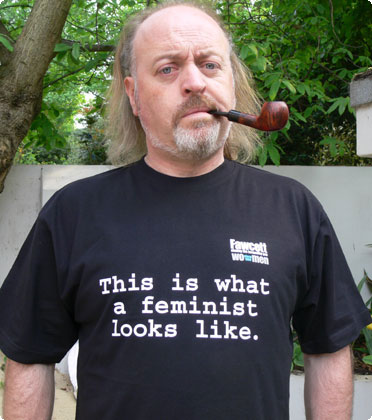
Of course I’m a feminist – who isn’t?

Pic: Fawcett Society

For International Women’s Day, a favourite picture of the ideal of feminism. (I have the t-shirt too, but look nothing like as good in it).  More pics, campaigns and info at the Fawcett Society

Politics and Procreation

Anyone who has ever studied history or read almost any novel written before 1900 will know that marriage has always been a contract about property and money, with romance a very poor second.  What absorbed Moll Flanders and appalled Edith Dombey was the knowledge that the only way a woman could enjoy status and security was to snag a solvent husband.  Single women didn’t count.  Divorce was beyond the pale. (Winter being a time for long evenings reading classic novels, I’ve been up to my neck in corsets and corsages since before Christmas. The references will get more contemporary as we get closer to Spring).

Fortunately families have evolved since the 1840s, although politicians don’t seem to have kept up.  This morning’s radio scrap between Ed Balls and David Willetts,  about whether or not it’s worth paying people to get married, was infuriating for its reactionary (Tory) assumption that the only families that count or work are married ones,  and the patronising ( both of them) assertion that government knows what’s best for families.

The magical properties of marriage have always baffled me.  I got married for tax reasons, so maybe the Tories have a point –  finance can work as a stick to drive people towards the registry office.  Whether or not you should wield it is a different matter.  We were together for ten years before we married and we had two children.  I felt not one whit more committed to the three of them after I had a ring on my finger than I did before and I defy anyone to tell me that we weren’t  a “proper” family during the time we were living in sin – which sounds so much more exciting than the reality of nappy rash and teething rings.

There is a job for government on this issue.  But it’s around dispelling the myths that surround “common law marriage” rather than frog-marching couples up the aisle.  Let the unmarried know their rights (or lack of them) to property and pensions or decisions affecting their children.  Then butt out.  Let us make our own choices about how we want our families to be and leave us to get on with it.

Hating the Daily Mail – a game for all the family

Read over someone’s shoulder on the tube an ad  in Metro for today’s Daily Mail:  “What to do when your daughter is obsessed with her weight – AT JUST SEVEN?” And I think we can all agree that poor body image, an obsession with weight and diet and an unhealthy fixation on being thin are a curse affecting women from an increasingly young  age.

Can I suggest that one answer for the writer of the article is “don’t ever let her look at the Daily Mail”?  Yesterday’s Metro (seen the same way, I never actually pick the damn thing up) carried an ad for the Mail crowing:  “The brilliant article all women should read – what’s YOUR fat age?”  Apparently Carol Vorderman is really 48 but has a fat age of 50 – evidently got some work to do, eh Carol?  I looked at the site to get the link and saw that the top picture on the home page is of actress Kirstie Alley (or “bloated yo-yo dieter Kirstie Alley” as they describe her) grimly promising to get back into her bikini.

Why any woman should read the Mail – far less write for it – is a mystery to me.  It hates us for being too fat and too thin; for worrying too much about our weight and for not caring enough;  for going out to work thus neglecting our children and for staying at home and wasting our potential.  It thinks we dress too young for our age and too frumpily, and  is constantly on guard to warn us about the horrible diseases of mind and body that we poor weak creatures are prone too.

The Mail is so successful among women that we must really like this stuff.  Perhaps the female equivalent of Englishmen  who like to be spanked is women who like to be told by Paul Dacre that they are rubbish. I remember reading an interview by Irma Kurtz, who used to write the agony column for Cosmo in the UK and US edition.  She said that the big difference between the two sets of readers was that while  an American would ask “why on  earth is my boyfriend treating me like this?” the Brits would ask “what did I do wrong to make my boyfriend treat me like this?”  But at least the Mail is always on hand to  point out our errors. As it said in my favourite  Mail headline of all time, last summer “Why single women who say they’re happy are lying  (trying to find the link I put “single women who think” into the Mail search engine and the page crashed…)