Is government communications more than press relations?

I was badly sidetracked from what I’m meant to be doing today by a podcast of an event from the Institute for Government What Next For Number 10 Communications? Inevitably the  focus of the event  –   “the role of the Number 10 Director of Communications” – was about press relations.  A distinguished panel of former prime ministerial press advisers and senior journalists was assembled to talk about the role facing Craig Oliver, David Cameron’s new Director of Communications.  It was a fascinating insight into the trials and tribulations of a press handler’s life.  But it did leave the impression that the only kind of comms that matters in government is press relations.

For anyone who’s worked in any other comms discipline in government this will sound familiar if dispiriting.  For understandable reasons most Ministers are focused most of the time on how they are going down in the press.  Other comms approaches don’t seem to have the same resonance with them – even though they might offer more effective ways of communicating directly with the public.

Meanwhile, the review of government comms chugs along, and is due to report soon; and the current Head of COI,  has just announced that he’s leaving for pastures new, giving some the impression that COI’s days as a significant player in government comms may be numbered.

I raised some of the questions I’d like to see answered in the comms review  here.  In particular there are big issues to be addressed around the potential of  new media approaches in government comms.  The only question  I heard raised at the IoG’s event about the role of the internet  (by the only woman’s voice I heard at the entire event) wasn’t answered  by the assembled gentlemen of the press (which chairman Nick Robinson described, without apparent irony, as “a cosy Radio 4 reunion”).   Perhaps my Twitter hero, Sir Bonar Neville-Kingdom  “HMG’s data sharing Czar”, is closer to the truth of the government’s approach than I’d  imagined (sample tweet:  We could use the Internet to allow people to connect directly to Whitehall, like a sort of Departmental Ceefax, via wires as it were.)  Can I put in a request to the IoG that now they’ve looked at issues of the press they could turn their attention to the other forms of government communication and debate them?  I’d go.
Good writing saves lives

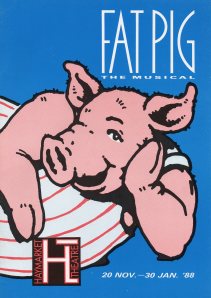
The news story that instructions on medicine bottles are being re-written because people find the language they use too complicated, took me back to my first proper job, writing copy for the publicity department of a regional theatre.  I was laughed out of the room for suggesting that we should change the phrase “affix stamp to envelope” on the  letter sent with the season’s brochure to “please use a stamp”.  Affix was the ‘proper’ word to use.  That’s what we were going to stick with.  It was evidently more important to them to sound posh than be understood.  (They also veto-ed my suggested tagline – It’s Swine-sational! – for a Christmas musical based on the children’s book, Fat Pig.  They were idiots and didn’t deserve me.  But it’s OK, I’m over it now.  Really.)

The standard advice given on copywriting courses is to remember that the average reading age of adults in this country is about 11, so you need to  KISS (variously Keep It Simple, Stupid; Keep It Simple, Silly; or Keep It Short and Simple depending on the whim of the trainer).

Writing short, snappy, clear copy that’s  fun to read and sells a product – or gives advice about how to use a medicine properly –  is much harder than it looks.  Maybe that’s why there is so much copywriting advice available online.  The American site Copyblogger is one of my favourites – its 10 steps to becoming a better writer advice is spot on.  I subscribed to Naomi Dunford’s newsletter for a while, even though it wasn’t particularly relevant for my business, because I liked her bracing “get off your ass and get down to work” style.

Copywriting really matters.  Poor writing skills will lose you contracts, customers and sales.  There’s some good advice here about ways to improve your writing – the most effective tip is simply to read.  Lots.  Of all kinds of different writing.  Think about what you enjoy and try to understand why it works.  And if it doesn’t work, try to understand that too.  Medicine bottle-labellers are doing that right now.  Who knows.  If they find the right words it might save someone’s life.

5 ways to become (slightly) happier

I immediately warmed to the title of Oliver Burkeman’s event at the RSAHow to Become Slightly Happier.  There’s something pleasingly modest, reassuringly self-deprecating, politely English about it.  It won’t transform your life, it won’t make you rich, it might just, perhaps, help you deal with grey Monday mornings.  I like his sense of scale.

Having studied a mountain of self-help books, he has come up with some top tips for things which seem to work.  Thankfully they run counter to the mass of advice to transform your life through positive thinking which frankly just sounds exhausting (this in-built sloth might explain why my favourite tip is number 4)

  1. Leave your thoughts alone.  Don’t work  hard on trying to think positively, don’t be yanked off course by negative emotions but don’t try to squelch them either.
  2. Write your problems down – don’t try to solve them, just externalise them.
  3. Cultivate randomness and new experiences rather than trying to control your environment.
  4. Have really tiny goals; goals so laughably small that they can pass under the radar of the bit of the brain that predicts failure. Apparently Burkeman carries an egg timer around with him so that he can time  his goal to do two minutes of work at a time on difficult projects;  he knows people who have  got fit by starting with a brisk walk for 30-seconds every day.
  5. If bothered by perfectionism go into work one day and try just to be mediocre.  Try to function at about 60% and see what happens when the constant pressure to make everything perfect has gone.

There are of course related issues to think about here – do we really need other people to tell us how to be happy? Does paying for the advice make it more credible – or more likely to work? What is it about our society that seems to make so many people unhappy?  Is being unhappy (in small doses) a bad thing?   If there was no unhappiness would there be  progress? ( a question from the RSA audience, which prompted me to think – if there is no unhappiness does it matter that there’s no progress?)  But I’ve been writing this for more than 2 minutes already, and today is my day for being mediocre, so I’ll leave other people to wrestle with those.  I’m just going to re-set the timer and do at least, two averagely OK minutes on my new business plan.

Getting Lippy about violence against women

I’ve been putting off blogging about Nazziwa’s story because I have no idea what to say about it.  Watch, but be warned it’s not a comfortable few minutes.  Nazziwa’s husband routinely beat and threatened her and has cut off both her hands – for which he has been sentenced to a mere 10 years in prison.

What can you possibly say that isn’t a platitude, apart perhaps from just howling with rage?

Nazziwa’s story is part of Action Aid’s Get Lippy campaign for International Women’s Day.  The campaign site carries many other women’s stories and gives a chance to send  messages of support to them – which will appear like this at their destination.  Please do. It feels important to let them know that they are not alone.

In praise of the unknown unknowns

Flickr: dweekly

I liked Jonathan Freedland’s piece in today’s Guardian about how the internet has changed the way we think.  His list of good outcomes was as you’d expect  – the ability to connect with anyone, anywhere;  access to more information from further away faster than ever before, permitting the spread of ideas at a rate undreamt of by previous generations.

Freedland’s anti-internet arguments ring true too – more information faster can mean less in depth; information that is updated every few seconds can mean shorter attention spans.  He missed, though the thing which is starting to really bug me about the internet  – its tendency to reinforce what I already know without surprising me with things that I don’t.

The classic example of this is  Twitter’s “people like you” list of recommendations for who to follow.  I tweeted, semi-flippantly, the other week that what I need is the ability to build a “people entirely unlike me” list for moments when I’m in need of a good row.  I try to widen the range of voices I listen to on Twitter,  but if you analyse the list of who I follow  it’s still largely metropolitan, left-leaning politically, linked to the industries I work in.   There’s nothing wrong with listening to people you agree with, but it becomes problematic if you forget that there are other shades of opinion out there – it’s like being in the pub before a game and then getting to the match and realising the other side has fans too as someone tweeted about  campaigning at a local council by-election recently.

The sense of only being offered what you already know you like isn’t confined to Twitter.  Anxious to maximise sales, all online retailers  highlight things based on your purchasing history (we have recommendations for you...) and on what people with similar taste have chosen  (customers who viewed  X also viewed Y).  Whatever your interests are you can follow them online as long as you know what to search for. But what happens to all the interests you might have but  haven’t discovered yet?  Search engines only work if you know what you’re looking for – how can I search online for an opinion or a writer or a piece of music to change my life  if I don’t already know that it exists?

I don’t agree with Donald Rumsfeld on much, but in one thing at least he was spot on:

There are known knowns; there are things we know we know. We also know there are known unknowns; that is to say we know there are some things we do not know. But there are also unknown unknowns – the ones we don’t know we don’t know.

The internet is great at helping with the known knowns and the known unknowns (it’s what Google was invented for).  It’s the unknown unknowns I’m interested in; the serendipitous discoveries you can make in an afternoon’s browsing in a proper bookshop or a library; listening to a radio station rather than trusting the genius recommendations on iTunes; finding an unexpected twist to a news story from the pages of a newspaper rather than just scanning the front page online. So, in the spirit of discovery, here’s a list of 100 things we didn’t know in 2010.

Getting Lippy about forced marriage

All of the short films in Action Aid’s Get Lippy campaign for International Women’s Day are well worth watching.  There are some fantastic and humbling stories about courage in the face of terrible injustice.  One story that really caught my attention, was Mina’s.  She was given away in marriage as the settlement for a family feud when she was 6.  She hasn’t seen her parents for more than a decade.

It is incomprehensible that any parent could do this to a child (though I’m extending my sympathy to Mina’s mother as well as Mina herself: I’m guessing she didn’t have much of a say in the transaction either).

Hers is, sadly, not a rare story in Afghanistan.  It’s not unknown here either – though you’d hope not for such very young girls.  I was horrified when I worked on the last government’s strategy for dealing with violence against women, to discover how many instances of forced marriage  take place in this country each year – the UK Foreign Office’s Forced Marriage Unit, dealt with 1,600+ cases in 2009.

Mina must be incredibly courageous to survive her experience and then have the guts to start campaigning for women’s rights in Afghanistan.  You can send her a message of support through the campaign site .  Spare a thought too for the women and girls from this country who are facing a similar fate.  Definitely something to get lippy about!

Government comms – cock-up or conspiracy?

I’m amused that people are claiming to see dirty tricks afoot in the government’s climb down on the forestry sell-off.  There was a round of applause when it was suggested on last night’s Question Time that the whole thing was a set-up to present the government in a caring and listening light and to deflect attention from more nefarious goings on in health and education.

Having worked in Whitehall, I’m always amazed that people think government is efficient enough to put a conspiracy together.  Given the choice between something being down to cock-up or conspiracy I would bet the mortgage on it being a cock-up every time.  Government is too big, leaky, dumb and chaotic to manage the nimble footwork, discipline and cunning required to manage a conspiracy,   it certainly couldn’t raise the wherewithal to do it over this.  The simplest explanation is the best – they messed it up, didn’t listen to anyone before they announced the policy, hadn’t thought through the politics of it and were astonished at the response.  Another one to chalk up to my growing list of examples of how bad government comms is at the moment.

Perhaps David Cameron’s past life as a PR came to his aid when he killed the policy.  Standard advice  in crisis comms  is to act swiftly and decisively, accept blame where it’s due, put counter-measures in place fast and apologise sincerely.  All of which they more or less achieved.  I do wonder about the longer term damage to the Tories’ corporate reputation, though.  Ed Miliband has already made the point that cuts are reviving memories of Thatcher and “re-contaminating” the Tory brand.   At least the Thatcher governments maintained a reputation for being steadfast in the face of opposition. How many more U-turns driven by poor policy planning  can this lot afford before their public image is of malign but incompetent toffs blundering through things they don’t understand?

Password rage

  • 13 passwords for different computer/phone-type accounts (Blackberry,Twitter, WordPress, Skype  etc).
  • 20 passwords for accounts with professional associations, companies I do business with etc.  Inexplicably this list includes 2 usernames for different bits of the Business Link site, each with its own password, oh, and a 12-digit government gateway ID.
  • 9 house-related accounts – utilities companies, banks, insurance company etc, and
  • 5 other accounts – which aren’t even mine,  I just keep track of them for the children

The pain of setting them all up has faded with time, but I know some of them have separate usernames attached, some of them don’t, all of them have passwords –  memorable, unguessable, mixing upper and lower case letters, numbers and symbols to a dizzyingly complex degree.

And when they work it’s fine.

And when they don’t and you spend, as I just have, 15 sodding minutes going round and round the cycle of failing to log in, resetting the password,  re-entering the new password and the screen continuing to do that bloody annoying little sideways judder that’s probably supposed to be cute, but that  tells you that you’re going nowhere,  how in the name of all that is holy do you prevent yourself from smashing a shoe through the screen?

Fran Lebowitz – a fan girl writes

As soon as I knew who she was, I wanted to be like Dorothy Parker.   I was immoderately impressed that, when she was challenged to make up a joke using the word horticulture,  she instantly quipped:  “you can lead a horticulture, but you can’t make her think”.  I was about 12.

When I hit my early 20s I wanted to be Fran Lebowitz instead.  Having watched Public Speaking last night, I think I still do.  The poise.  The wit.  The 1970s New York taxi sprayed “such a subtle shade of pearl grey that straight men think it’s white”.  The fabulous self-possession  (“Who do you go to when you need a second opinion?”  “Why would I need a second opinion?”).  The pride in being  smart and funny and caring about art.  

She is shamelessly, gloriously elitist.  We lesser mortals should leave the business of writing to the truly talented.  “Too many people are writing books.  Period.  And the books are terrible.  And this is because they have been taught to have self-esteem.  And apparently they have so much self-esteem that they think ‘you know what?  I shouldn’t keep these thoughts to myself.  I should share them with the world!’…Well, no your book is not as good as anyone else’s.  Your life story would not make a good book.  Don’t even try it.” 

She doesn’t care what we think about current affairs, either.  “You know on the news, when they put up the Twitter number – whatever it is, I don’t really understand – and say ‘we really want to know what you think?’  I think: ‘Do you?  I really don’t'”.  

I became a fan without reading her books – they were hard to come by in Midlands’ bookshops in the early 1980s so I had to make do with newspaper articles and the occasional profile. It seems as though they are still a minority interest – there are three second-hand copies of Social Studies listed on Amazon, prices from £116.  Metropolitan Life retails at a slightly more affordable £29 but second-hand copies again, so I assume she’s out of print here. I ordered the collected essays to read straight away, but will resume my second-hand bookshop-scouring until I find the originals. 

Watch the film, you won’t be disappointed.  Who wouldn’t warm to a woman who can say:  “Whether people seek my advice or not, it’s really pleasurable knowing everything.  I’m sure that people think ‘she doesn’t know everything’.  They’re wrong”.

How many poll taxes fit into an area the size of Wales?

There are many shorthand measures used by newspapers to indicate size: Wales for geographical area, Wembley for crowds, swimming pools for volume, Nelson’s column for height, double-decker buses for dinosaurs (a rather specialised subset).  There seems to also be one newspaper measure for showing just how big a problem a politician has got himself into: the Poll Tax.

For Blair, ID cards, university top up fees and inevitably Iraq all got the “Is this Blair’s Poll Tax?” treatment.

Gordon Brown had fewer Poll Tax moments – perhaps he just had less time to stumble into them, although Polly Toynbee was worried that it might be the Tube.

For David Cameron, overwhelmingly it’s NHS reform, although Socialist Worker wants it to be tuition fees,   Labour Uncut feels it could be the housing crisis  and the TUC is warning about the whole package of cuts.

How young do you have to be before the Poll Tax ceases to be meaningful as something which happened during your political lifetime and becomes something that has to be set into context – in the same way that I had to have  Suez explained when it was the standard measure for British humiliations in world affairs (I grew up in the 1970s, there were LOTS of those).

The Poll Tax riot was in 1990.  Thousands of people who voted in the general election  weren’t born when it kicked off.  Does it mean anything to them or is it time for the hacks to stop being lazy?

Update:  Just checked, following today’s Big Society-debacle headlines.  No-one has actually called the BS David Cameron’s Poll Tax – yet.  The WSJ has already described the Big Soc as “the silliest idea to have come out of the party since the Poll Tax” so it’s probably only a matter of time.