Two simple steps to world domination

The world is full of advice for business owners of all kinds – about social media, about HR and finance about Lord knows what else.  I’m in the business of doing it myself.  I’ve come to the conclusion tho’ that the secret of success is much, much simpler than anyone would lead you to believe.

Want to be a standout success in business?  Simple:

  • Be competent – that just means do what you say you’re going to do, when you say you’re going to do it, to a basic standard of OK-ness, using a basic filing system that helps you keep track of what’s going on.  That way your customers will love you and will not ever have to  wonder how to prove to you that they have indeed paid invoices you seem to believe they haven’t.
  • Be polite – that means saying please and thank you.  It means letting people know BEFORE they work over the weekend to deliver the thing you  asked for by Monday that you won’t be in the office until Wednesday.  It means telling people  whether or not you want to use them on the project you floated past them several weeks ago, not letting them try to work it out by gazing at their tea-leaves.

That’s it.  If you can master these two skills you will be so unusual, so astonishing, so much in demand that books will be written about you.  If you can also manage

  • Be on time

You’ve definitely cracked it.

Bad day?  Me?  Whatever gives you that idea?

Lipsmackingthirstquenchingacetasting…

Talking about the dark ages of communications – I had a weird flashback moment to them this morning when I saw a piece about royal weddings in the paper,  illustrated with a picture from a Charles and Di street party in 1981.

There in the background was a Richard Shop – (a late and unlamented high street fashion chain, for younger readers.)

I could INSTANTLY remember all the words to the Richard Shop TV campaign – if you’re my age I bet you can too (google Richard Shops, there are pages and pages of sites devoted to it).  All together now:

Richard Shops are filled with all the pretty things/ soft and lovely pretty things to wear/  Hey there pretty face/ Make the world a prettier place/ Come pretty face/ Come buy your clothes at Richard Shops 

Thank God I was alone in the kitchen.  It led to a medley of classic 1970s/’80s advertising jingles which would have amazed and astounded my children, had they been there.

So, 2 questions:

  • Where the hell is this stuff stored?  Why can my memory  file and recall it so effectively, without being asked to, when so much else – the date of my next VAT return, for example – seems so much more elusive; and
  • Why don’t advertisers use songs like this in advertising any more?  They evidently imprint brand names on customers’ memories for decades.

I genuinely cannot remember a single recent ad for either Pepsi or Coke, but You Tubing the I’d Like To Buy The World A Coke song bought a nostalgic tear to my eye and, through the lump in my throat,  I could sing along with every word (and I really hate Coke) .

#Meh2AV – dumb and dumber go campaigning

There are just a couple of weeks to go before the end of the campaign but I still can’t quite make up my mind.  What has been the worst piece of political campaign material in the AV debate so far?

I thought No had the edge in irrelevant stupidity with the “This baby needs an incubator not an alternative voting system” ads.  Then I saw the  Yes TV ad which has MPs running scared while people yell at them through megaphones.

Both sides are taking part in the customary celebrity arms race – Yes has royalty in the shape of Colin Firth and Helena Bonham CarterNo seems to have bagged Peter Stringfellow (hmm).   The best comment I’ve seen so far on this game of Celebrity Top Trumps was  Armando Iannucci’s:

Loads of celebs in AV debate. If YES wins you get Eddie Izzard, NO gets Rik Mayall. As a 3rd rate celeb, I’ll hold the balance of power
 
No  seems to have the edge in playing the man not the ball (vote No because Nick Clegg wants you to vote Yes.  Vote No because otherwise the BNP will get elected – even though there’s IPPR research to suggest they won’t ).
Yes is pinning its hopes on the fact that we are so disgusted with “our broken political system”  that we want to punish MPs by changing the way they’re elected.
What we’re missing is a sign that anyone connected with either campaign is thinking about anything other than slinging mud at the other guys.  Is anyone analysing what the audience might actually want or need to know before they decide to change – or not change – the voting system?  Because  if they are it’s not showing out here in the real world.
There are few precedents for how to campaign in a referendum when political parties are split.  The obvious one is the  1975 referendum on membership of the EC. I don’t remember it myself,  so I looked it up to see what campaigning was like back in communication’s dark age:
Television broadcasts were used by both campaigns, like party political broadcasts during general elections. They were broadcast simultaneously on all three terrestrial channels: BBC 1, BBC 2 and ITV. They attracted audiences of up to 20 million viewers. The “Yes” campaign advertisements were thought to be much more effective, showing their speakers listening to and answering people’s concerns, while the “No” campaign’s broadcasts featured speakers reading from an autocue
 
Listening to and answering people’s concerns, eh?  What will they think of next…   They had really informative (though extremely long) leaflets about the issues too.
AV is a classic example of a campaign that no-one wanted or believes in.  The No-s think it’s a sop to the Lib Dems to keep them onside in the Coalition.  The Yes-es really want to be talking about PR.  And it really shows.  It’s not just that I feel personally insulted by their rock-bottom estimation of my intelligence.  I also feel professionally ashamed of the woefully low level of  comms skills on display.
No wonder it’s been estimated that voter-turnout where there are no local elections could be as low as 20%.  Electoral reform is always going to be a tough comms sell. But what a wasted opportunity to have a grown-up debate.

The rise and rise of the #Mumpreneur

A brief and good-natured Twitter spat between me and Marketing Donut about their “Mumpreneurs Week” made me think again about women and business. And I’m still baffled.

I am a mother.  I have a business.  Without me even having noticed, this  makes me a mumpreneur,  eligible to attend special conferences and receive my own awards.  I have no idea why.

I won’t repeat the  questions I raised in the “Is business really harder for women?” post except to say that on none of the mumpreneur supporter sites I’ve speed-read this morning have I found any advice that applies exclusively to self-employed mothers or answers a problem that’s only faced by mothers.  The advice – and it’s generally very good advice – is about time and resource management, about planning and budgeting, about choosing between working at home or finding premises, about marketing.  All of that stuff is relevant to start-up businesses whoever they’re run by.

The one issue that’s raised consistently on these sites that doesn’t featured much on the CBI‘s is, of course, childcare.  There’s an awful lot of “how heroic it is to juggle children and your own businesses” when actually the focus should be – “how heroic  working parents are to juggle childcare and working life in the absence of available, affordable childcare“.

A lot of us mumpreneurs (I’m trying to get  used to using the word – there may be a grant in it eventually) have opted out of regular working life and into self-employment precisely because it offers an easier way of managing the work/ life thing.

Personally when I was in full-time work I got tired of being tired: of running everywhere and always being late anyway; of worrying that I wasn’t  a good enough employee nor a good enough mother;  of having to negotiate flexible working hours but still not being able to attend school plays; of worrying about work when I was at home and about children when I was at work.  And I say this despite the fact that my husband has always done more than his share of childcare – not because he’s helping me out with something that’s really my responsibility, but because it’s a shared responsibility.

Being a parent and running a business is tough.  But in my experience it’s no tougher – and in some ways it’s a lot simpler – than being a parent and having a job.  Oh, and while I’m at it.  Why are there no support services for Dadpreneurs?

What is a sole trader?

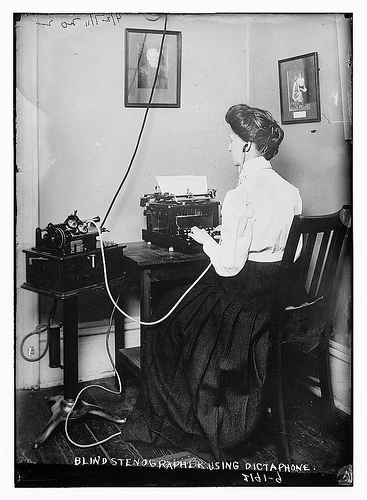
Library of Congress 1911

There’s a discussion going on over at LinkedIn about what it is that makes people go freelance.  Reading the comments started me thinking about a more fundamental question.  Not “what’s so attractive about freelancing?”, but “what is a freelancer?” – or given the title of my blog, “what is  a sole trader?” And do they count as businesses?

 When is a business not a business?

This is not such a dumb question as it seems.  The most common search terms that land people at my blog are about sole trading – from the slightly baffling “Is Rupert Murdoch a sole trader?”, to the more general “What is a sole trader?”

The dictionary definition is helpful, but being a sole trader is a slippery thing to pin down. (By the way, I should say that I’m using the terms freelance and sole trader interchangeably to mean one person working for him or herself.  They aren’t necessarily the same thing.  And to be strictly accurate, I’m not a sole trader myself: I’m a Limited Company.  I just didn’t think Limited Company PR was a good title for a blog.  There’s some advice on the differences between sole trading and limited companies here)

Anyway, whatever you call me, I  am a business.  I’m registered at Companies House and with the VAT office.  I have an accountant to help me sort out my corporate tax.  My heart swells with pride when we entrepreneurs are hailed as the saviours of the British economy.  But I’m also not a business as its commonly understood: I don’t have premises (I work from clients’ offices or at home) I don’t have staff, I don’t sell a product other than the ideas I generate, so I don’t have production line, warehousing or distribution problems to solve; I don’t need much equipment (printer, laptop, phone, kettle).  I work with lots of small businesses who face all these issues, so I understand the problems.  I just know that I don’t share them.  And neither, I’d guess do many of the 3.6million other companies without staff – rather insultingly classed as “zero businesses” – which are estimated to be in operation at the moment.

Advice for Sole Traders

This seems like a small point, except when it comes to looking for ideas for developing my business.  Small business advice services are geared up to help the businesses with the staff and premises to worry about.  There isn’t much for me on the recently launched (and already much derided) StartupBritain though as my needs are pretty simple  I can work out most things for myself.   But, just in case Rupert Murdoch’s reading and is thinking of branching out as a sole trader, here’s some online advice (though I’m not a tax, insurance or legal expert, so I’d seriously advise him to check with a professional)

Marching up and down again

I didn’t demonstrate about anything until I went to university and experienced the joy of yelling “Coal Not Dole” at bemused Saturday morning shoppers.  I was one of hundreds of nicely brought up, middle class kids who’d never been anywhere near a coalfield but liked the frisson of shouting loudly in public and the certainty that “we” were on the side of right and “they” would have to listen to us.

My political understanding has got a lot more sophisticated since then, and my expectation that marching achieves anything has lessened considerably, but I still find it moving to be part of a crowd of people, making a point by the simple act of coming together.

My 13-year-old daughter is years ahead of me as a marcher – she was already a veteran of two anti-cuts demos before she joined me at the TUC march to Hyde Park yesterday.  (If nothing else, the government is doing an excellent job of politicising young people.)  And she, like me, thought it was great.

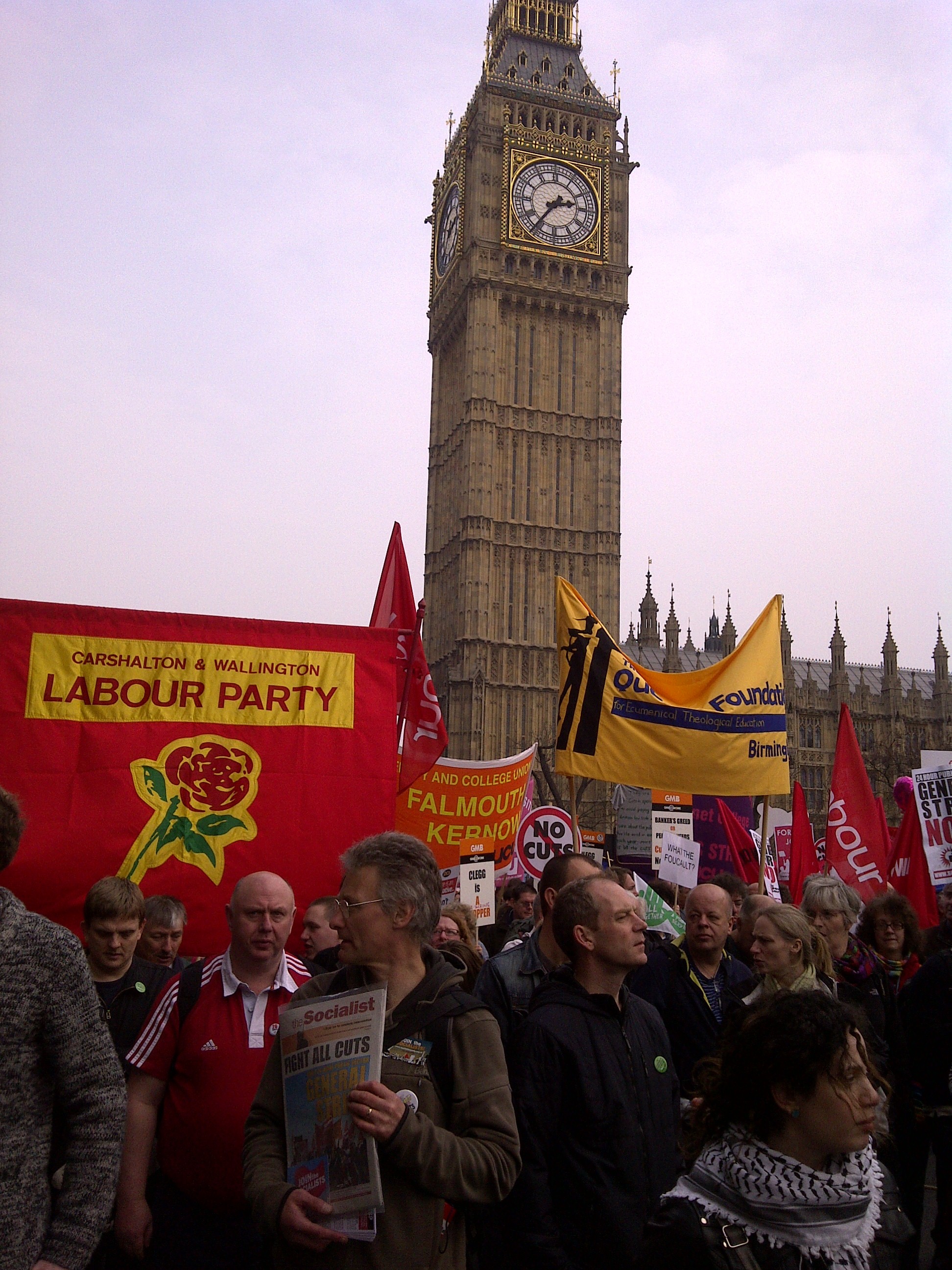
I burst out  laughing when, under the bridge by Embankment station, a brass band started playing and the crowd started to dance.  She chanted  along to all of the most scabrous political slogans (I’m telling myself that she doesn’t know what some of those words mean…) I’m glad I went and I’m glad she did too, even though it means she’s likely to be disillusioned about marching early on in her protesting career: the wrangling about how many people were there  (“at LEAST 500,000” according to her – half that according to the papers); the fact that a handful of idiot protesters whose actions are endlessly looped on the news can become the way that an event is remembered.

Having tweeted that everything was calm and peaceful on the route, I was called a muppet and a moron for not realising that the event was actually a hotbed of rioting anarchists throwing ammonia-filled lightbulbs.  “Take your blinkers off” I was urged by someone apparently watching events from his sofa, in between following the England – Wales game on TV.

Rebecca insists the whole thing was worthwhile:   “It was really good and the 100-odd idiots that decided to throw paintbombs, missiles and fireworks at people completely hijacked the entire march and took it away from us.”

I agree with her – though I also agree with the man quoted in today’s papers: “I think this march is a pretty futile gesture.  I don’t think politicians respond to protests.  But sometimes futile gestures need to be made and there’s comfort in being with other people who feel the same way.”

There’s been lots of nonsense spoken about yesterday – quite a lot of it by the marchers themselves (however cute the March Like An Egyptian placards looked, this is not Egypt.  Cameron is not a Mubarak-style dictator.  Trafalgar Square is not Tahrir Square.  The news story about Libyan woman Iman al-Obeidi in today’s papers should highlight how ridiculous those comparisons are) It was just a heartening  example of people standing up to be counted for something they feel is important, and that in itself is something to celebrate.

67 pieces of advice for small businesses and start-ups

I have a magpie habit of spotting stuff online and parking the link to it, intending to come back later.  Things have been particularly bad recently as I’m working on a new project, to be launched on an unsuspecting world in the next couple of weeks, so I’ve been hoarding advice aimed at start-ups and micro-businesses.

As a way of clearing the decks, here are 67 tips for new, small businesses gathered during my research.  And no, I’m not doing them all myself.  Yet.

Business planning and starting from scratch 

Social networks

Communications – the right words and the pictures

Consultancy and freelancing

  • A Q&A from The Guardian about the pros and cons of becoming a consultant.  This is specifically about the voluntary sector but lots of the issues are universal.
  • Is there life after freelancing? Questions to ask yourself if you’re thinking of trading up from being a freelancer to setting up a small agency
  • Freelance Adviser general advice on a range of subjects for freelancers

Is business really harder for women?

Feminist to my fingertips I may be, but I’ve never been one for all-women events.  So I should have known that going to Business Link’s Women in Business networking event probably wouldn’t end well.  But … I’m trying to launch a new project, and if there’s advice to be had or a potential market to tap, it seemed worth sampling.

Then I went.

Trampolining for success and Feng Shui-ing Congleton

“It’s so fantastic to be here with all you girlies.” trilled our keynote speaker.  She insisted that we”girls” weren’t entrepreneurs with a strategic vision for business  – “that’s the boring words”.  We were “dream catchers”, with a “team dream – to be MAD – Making A Difference” as we brought love and hugging to the world of business.  I remained seated as we were encouraged to stand and shout out our mantra:  “I am amazing!  I am incredible!  I am fantastic!”  Apparently it works best if you shout it to the universe first thing in the morning, while trampolining.  I spent an entertaining few minutes trying to imagine other successful women doing this – Margaret Thatcher?  Margaret Mountford from The Apprentice? –  but found it strangely difficult.

The kicker is, of course, that I was the one sitting sourly in the audience planning a dash for the drinks table.  She was the one on stage with £50million in the bank, advising Vince Cable on entrepreneurialism and living her dream of Feng Shui-ing Congleton (really).

The ditsy route to success?

This means one of a number of things: either kooky and wacky is the way ahead in business (I  doubt it); or women have come so far that however ditsy we are, we can still be taken seriously (debatable); or it’s an act to disguise the fundamentally unfeminine pursuit of managing things (I hope that’s not the case now, though it may have been 20 years ago); or it’s just patronising drivel. You’ll be unsurprised to know that that’s my preferred option.

Women as entrepreneurs vs women in the workplace

Ironically, the last place you should have to play the air-head is in your own business – your gaff, your rules.  The statistics on women starting up business suggest that women appreciate the freedom that self-employment offers and are making a success of  it.  The least they deserve is to be taken seriously and treated like adults – especially by other women.  I read one consultant recently recommending that a way to get women to think about business planning was to tell them that it was like preparing a shopping list – dear God …

There are, undoubtedly, big issues facing women in the workplace.  The statistics on equal pay and the gender imbalance at the top of  major corporations suggest that women are  still at a disadvantage in business.  And, of course,  there are barriers to  joining the ranks of the self-employed too.  I’m just struggling to think of many that are unique to women.

Are women’s businesses different?

These are the characteristics which were shared by the 50 fastest-growing women-owned business in the US last year:

  • A commitment to high growth — 71% agreed or strongly agreed that their goal from the very beginning of their leadership of the company was to build a large company
  • Inspiring leaders — 64% believe their “ability to motivate employees” is the most important characteristic for being a successful woman entrepreneur
  • Surrounding yourself with a skilled team – 78% say “Hiring the right people” was the most important action that contributed to their company’s growth
  • Adapting to a changing environment – The strategy most frequently chosen (64%) to meet the challenge of the current economy is to “enter new markets”. Sixty-one percent admitted current economic conditions caused them to change their business strategies

Those are the successful characteristics of businesses.  Not women’s businesses.  All businesses.

Having cast around for hints as to what the gender issues facing women entrepreneurs are, I found this which suggests our major problem is that we “care too much” And maybe we do.  I feel quite un-sisterly in criticising last night’s event. It was done with the best of intentions and may have helped hundreds of women.  But I’m nonetheless slightly baffled at the proliferation of organisations desperate to help us cope with the burden of being women in business.  Do we really need them? I’m genuinely interested to know.    The West Wing’s Ainsley Hayes would probably have a view. (If you’re short of time join her at 3.55′)